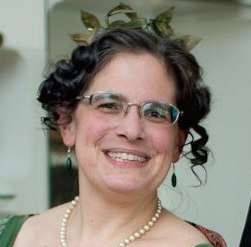
Author: Susan de Guardiola

  • The Union Dance

    • Era: 1860s-1880s

    The Union Dance is a short, schottische-like dance sequence which I have found in only two sources: Thomas Hillgrove’s 1863 A Complete Practical Guide to the Art of Dancing (pp. 170-171) and the 1883 Professor M.J. Koncen’s Quadrille Call Book and Ball Room Guide (p. 89)  The latter is a compilation of numerous other sources and the instructions therein are nearly identical to the earlier ones, so Hillgrove may be regarded as the preferred source for dating this dance.  Given the timing and Hillgrove’s location in New York, it is possible that the name of the dance was meant as a political statement, though it is also possible that it was simply the name of a tune to which it was danced or a completely random title.

    (more…)

  • The Pan-American Glide (a 1910s Schottische)

    An early anniversary gift for Michelle & Peter, who asked about 1910s schottisches:

    By the 1910s, the schottische had almost complete vanished from the ballroom floor.  But a few dancing masters were still creating variations, among them the “Pan-American Glide,” published in the F. Leslie Clendenen’s collection Dance Mad, or the Dances of the Day in St. Louis in 1914.  It is attributed to F.W. Bouley.

    The name of the dance does not signify anything special about it choreographically.  It appears to merely be one of many uses of the term “Pan-American” in the early 20th century, playing off of the Pan American Union (so named in 1910) and the 1901 Pan-American Exposition in Buffalo.

    (more…)

  • Regency & Victorian Dance Workshops, NYC (Sunday, January 4, 2009)

    I will be teaching two dance workshops for The Elegant Arts Society in New York City this Sunday, January 4th.  Logistical details are below.

    The first (1:00-3:45pm) will focus on the dances of the Regency era (1810-1820), including steps and figures for country dances, French quadrilles, and the nine-person reel known as The Country Bumpkin.  Specifically, we will dance and look at a step-sequences to use in L’Été and La Finale (second and fifth figures of the French quadrille) and will enjoy a Spanish Dance and an 1816 version of the classic Money Musk.

    (more…)

  • A Regency “Sir Roger de Coverley”

    In honor of the season…

    In his Complete System of English Country Dancing, published circa 1815, Regency-era dancing master Thomas Wilson proclaimed of the dance “Sir Roger De Coverley” that it was

    composed expressly for a finishing Country Dance, about 100 years ago, and derived its name from Addison’s Sir Roger De Coverley; so frequently mentioned by him in his popular Essays in the Spectator, and is the only whole Dance given in this System. The Figures of which it is composed being permanent and unalterable, and thereby differing in its construction from all other Country Dances.

    and explained its use as the final dance of the evening (or early morning, given the length of balls of the era):

    At all Balls properly regulated, this Dance should be the finishing one, as it is calculated from the sociality of its construction, to promote the good humour of the company, and causing them to separate in evincing a pleasing satisfaction with each other.

    (more…)

  • A Fancy Medley (1893)

    Throughout the mid- and late 19th century, dancing masters had mixed quadrille figures and couple dances such as the waltz, polka, schottische, and galop into single figures or entire quadrilles.  A popular variation on this idea was a “varieties” or medley quadrille in which each figure used a different kind of music and incorporated a different couple dance.  Such a one is this Fancy Medley, published in Boston in 1893 in The Prompter’s Handbook by J.A. French.  The three figures of the quadrille include a polka figure, a schottische figure, and a waltz figure.  The original instructions may be seen here (page one) and here (page two).  The individual figures are quite similar to some of French’s single-figure quadrilles, such as the Waltz Quadrille and Polka Quadrille discussed in earlier posts here (waltz) and here (polka) and bear a close family resemblance to other single-figure quadrilles of the era.

    (more…)

  • Regency & Victorian Dance Workshops, NYC (Sunday, December 7, 2008)

    I will be teaching two dance workshops for The Elegant Arts Society in New York City this Sunday, December 7th.  Logistical details are here.

    The first (1:00-3:45pm) will focus on the dances of the Regency era (1810-1820), including steps and figures for country dances, French quadrilles, and the nine-person reel known as The Country Bumpkin.  Specifically, we will look at a variety of step-sequences to use for L’Été (second figure of the French quadrille) and will enjoy a new Spanish Dance and the 1816 version of the classic Money Musk.

    (more…)

  • Light Dragoon

    • Era: 1850s-1860s America

    “Light Dragoon” is an easy mid-19th century American country (contra) dance, one of a lengthy list of contra/country dances given in two manuals written by Elias Howe.  In one of the two, it is cryptically labeled “Pinkerton;” possibly this is the name of the choreographer of the dance.  It is performed in a longways set of any length, though four to six couples is easiest.  All couples are “proper,” with the men standing to the left of their partners when all are facing the top of the room.

    (more…)

  • A Polka Quadrille (1893)

    By the end of the 19th century,  many quadrilles were being published that didn’t follow the earlier form of having multiple separate figures.  Although this short dance does have two distinct parts, they are treated as one long figure.  The source of the dance is The Prompter’s Handbook by J.A. French, published in Boston in 1893.  The original instructions may be seen here.  There are significant similarities in the figures to the Waltz Quadrille from the same source, which I described in an earlier post, as well a a generic similarity to other one-figure quadrilles of the late 19th century, which typically involve a mix of very simple figures interspersed with the entire set dancing in couples (waltz, polka, galop, etc., depending on the type of quadrille).

    (more…)

  • Advancing & Retiring Sequences for Regency-Era French Quadilles

    For the fourth in my series of posts (previously: setting, crossing over, and chassez-dechassez) on the step-sequences usable for various Regency-era French quadrille figures, I’ve pulled together three easy sequences which may be used for the figure En avant et en arrière (advance and retire or, more colloquially, forward and back), in which some number of dancers move forward to the halfway point of the quadrille set and then backward to places.  It is an extremely common figure; in the first set alone, it appears in multiple figures: L’Été, La Poule, La Trenise, La Pastourelle, and the many versions of the Finale figure which incorporate L’Été.  The move is sometimes written simply as En avant deux (trois, quatre, etc.); the return backwards is implied unless otherwise specified.

    (more…)

  • Crossing Over Sequences for Regency-Era French Quadrilles

    As with setting, there are a number of different step sequences available for dancers to use in the Regency-era quadrille figure Traversez (cross over), in which a lady and the gentleman opposite her exchange places.  Traversez appears most notably in L’Été, the second figure of the first set of French quadrilles, and in the many versions of the Finale figure which incorporate L’Été.  Below I will give a sample of five of the easier step sequences that may be used to dance Traversez.  This is not an exhaustive list of all the period sequences I have for this move, but it should suffice for most dancers.

    (more…)