
Author: Susan de Guardiola

  • The Three-Slide Racket

    • Era: 1880s into very early 1900s

    The three-slide racket extends the two-bar repeat pattern of the one-slide racket previously described into a four-bar pattern which has a more galop-like feel and is somewhat easier to initiate.  It is described in the major dance late-nineteenth-century dance manuals of M.B. Gilbert and Allen Dodworth and in two minor compilation manuals, one of which (Cartier’s Practical Illustrated Waltz Instructor) names it “The Wave.”

    The instructions below are for the gentleman; the lady dances opposite.  The dancers start in a normal late-nineteenth-century ballroom hold with joined hands angled forward at a diagonal along the line of dance.  Like the one-slide racket, the three-slide racket follows a zig-zag track along the line of dance; there is no turning involved.
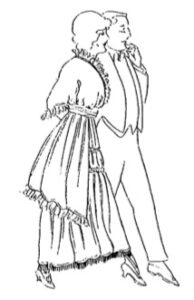

    (more…)

  • The Galop Racket or One-Slide Racket

    • Era: 1880s into very early 1900s

    The galop racket or one-slide racket is the simplest of the various rackets and is described under  both names in different sources.  In one Parisian manual it is simply “La Raquette,” though most other sources agree that “the” racket is a compound sequence mixing two different racket rhythms.  Prominent New England dancing master M.B. Gilbert explained it simply as “Pas de Basque sidewise” in 2/4 time.

    The instructions below are for the gentleman; the lady dances opposite.  The dancers start in a normal late-nineteenth-century ballroom hold with joined hands angled forward at a diagonal along the line of dance.  The dance follows a zig-zag track along the line of dance; there is no turning involved.

    (more…)

  • Introducing the racket

    The racket, or racquet, is one of the major new couple dances that began appearing in American dance manuals in the early 1880s and lingered into the beginning of the twentieth century.  It spread to France in the mid- to late 1890s.  I have found no information on its origins or reference to any creator.

    The racket is a lively dance that combines sideways slides and quick cuts of the feet back and forth.  It can be danced in both galop (2/4) and waltz (3/4) time, though galop time appears to be the default.  It was one of the few of the myriad couple dance variations of the last quarter of the nineteenth century to make it into manuals like Allen Dodworth’s Dancing and its Relation to Education and Social Life (New York, 1885, reprinted 1900), which for the most part included only the most commonly-found couple dances.  (He did include one of his own invention, the Knickerbocker, and the up-and-coming Boston.)

    (more…)

  • Round Two Step: A 1903 Dance Mixer

    Mixer dances, where all the participants shift partners at intervals, are useful icebreakers at dance events.  In A Complete Practical Guide to Modern Society Dancing (1903), Philadelphia dancing master Albert W. Newman offers a simple mixer for use with the then-fashionable two-step, asserting hopefully that

    This dance is rapidly gaining popularity, as it is most enjoyable.

    The dancers take partners and hold hands in a grand circle, with each gentleman standing to the left of his partner, and all circle to the left (clockwise).  The dance leader calls out a number (3, 7, 12, etc.), and all the dancers face their partners and begin a grand chain, giving right hands to their partners and pulling by, left to the next, right to the next, left to the next, etc.  As they move, they count people, starting with their partners as “one.”  When they reach the number called out by the leader, each takes ballroom position with that person and two-step until the leader gives a signal (typically a whistle), at which point all the dancers open up into a grand circle and once again circle to the left.

    (more…)

  • Five Step Schottische

    • Era: 1870s(?)-1890s (America)

    The Five Step Schottische, as described by prominent late 19th-century dancing master M.B. Gilbert in his tome of couple dances, Round Dancing (Portland, Maine, 1890) and later by Marguerite Wilson in her oft-reprinted Dancing (Philadelphia, 1899),  squeezes five movements, rather than the standard four, into each bar of schottische for an interesting variation which alternates sideways slides and half-turns for a sequence similar to that of waltz variations such as the contemporary Le Metropole (also included in Gilbert’s manual) or the later Five-Step Boston described by Philadelphian Albert Newman in 1914.  Putting this combination into schottische rhythm makes for an interesting but not overly complicated dance worth resurrecting by the modern late-19th-century dance reenactor.

    (more…)

  • An Easy One-Step Sequence

    F. Leslie Clendenen’s 1914 compilation, Dance Mad, is full of sequences of varying levels of difficulty for many of the popular dances of the 1910s.  This one caught my eye as being a short (sixteen beats) and simple introductory one-step suitable for getting beginners dancing quickly and for teaching the lead for rhythm changes between one-step and two-step.  Clendenen gives it no special name or attribution, just “One Step.”

    Directions are given for the gentleman; the lady dances opposite.  Starting foot is left for the gentleman and right for the lady.  Begin in normal ballroom position, with the gentleman facing along the line of dance.

    (more…)

  • The Three-Step Boston or English Boston

    Concluding a trio of posts on easy hesitation waltzes, here is the simplest hesitation at all: a normal waltz sequence stretched over two bars of music.  Albert Newman succinctly described the dance in his 1914 manual, Dances of To-Day:

    In reality it is our Standard Waltz, but instead of taking two measures this Boston takes four measures.

    What this works out to in practice is that the first step (forward or backward) of each half-turn is held for an entire bar (three counts) and the step to the side and close are done on the first and third counts of the second bar of music, with the overall rhythm being ONE-two-three-FOUR-five-SIX.  The three steps taken over two measures give the variation one of its names; I see nothing especially English about this that would account for the other.

    (more…)

  • The Pompadour Waltz

    The Pompadour Waltz is a minor but interesting variation on the five-step Boston or five-step waltz described by Albert Newman in 1914 (and by me here).  I have found it only in the collection Dance Mad, or the dances of the day, compiled by F. Leslie Clendenen and published in St. Louis in 1914.

    To perform the Pompadour, the dancers alternate brief hesitating grapevine sequences with the five-step Boston in an eight-bar sequence as described below.  The steps given are for the gentleman; the lady dances opposite.

    (more…)

  • The Five-Step Boston or Five-Step Waltz, 1914

    In his 1914 manual, Dances of To-day, Philadelphia dancing master Albert W. Newman describes a four-bar waltz variation he calls the Five-Step Boston or Five-Step Waltz.  Unlike the five-step waltz of the mid-19th century or the half-and-half of the 1910s, this waltz is done in the usual 3/4 waltz time, spreading five movements out over the six counts of music.  This is a hesitation waltz movement, well-suited the fast waltzes of the early 20th century.   It is easy to learn and provides a pleasant break from constant fast spinning.

    (more…)

  • Side by Side in the Half and Half

    The illustration at left is the last of a series of illustrations for the Half and Half taken from a small book of dance music published by Malvin M. Franklin in 1914.  For general information on dancing the Half and Half, an unusual 5/4 time waltz stepped on the first, fourth, and fifth beats, please see my previous post on basic traveling steps for the dance.

    In the illustration, the dancers have moved from a normal ballroom hold into a variant side-by-side position in which the lady’s left arm is stretched across the gentleman’s shoulders to take his left hand at shoulder height, while their right hands are joined behind her back.  In this position they move forward together with a series of “alternating steps then sliding steps” before, presumably, resuming ballroom position to continue the dance.

    (more…)