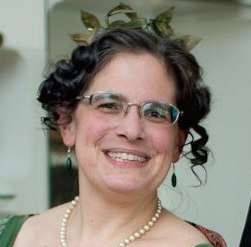
Author: Susan de Guardiola

  • Hot Chocolate

    I try to remember that history (dance or otherwise) didn't actually stop sometime before I was born, so today I'm flashing back to 1978 and the era of disco line dances and, happily, a flood of disco dance manuals.  I still find disco music very danceable, so ever so often I play around with reconstructing a few line dances to use as warmups or cool-downs at my own dance practices. 

    Here's a simple one: Hot Chocolate.  It's only sixteen beats long, which is a very short repeat for a line dance.  This may not be the easiest line dance ever, but it's got to be high on the list!  The dance might have been inspired by the group of the same name, probably best known for the mid-'70s hit song "You Sexy Thing."  The source is Let's Disco, no author given, published in 1978 by K-tel International, Inc. 

    (more…)

  • The Overlooked Eight Step

    • Era: 1910s
    • Dances: one-step, tango, half & half, hesitation waltz

    Why, in fifteen-plus years of dancing ragtime socially, had I never done the eight step?  It’s not an obscure step; it’s the first variation world-famous dance couple Vernon and Irene Castle give for the one-step and is also mentioned by them in their descriptions of the tango, half and half, and hesitation waltz.  And yet somehow I’d neither danced it nor reconstructed it until late 2007 when I was looking for interesting one-step moves for some new dance students.

    (more…)

  • How Many Times Do We Play That Tune?

    One of those questions I get asked all the time by musicians and others is “how many times through the tune for this dance?”  The reference is to progressive longways country dances, which were the dominant social dance form in Europe and America from the mid-17th century through the early 19th century and are still enjoying widespread popularity in various living tradition and revival forms.

    Modern English country dance and contra practice is for all couples to start the dance simultaneously, and the modern answer to the repeats question would be as many times as needed for everyone to enjoy the dance and fewer times than it would take for people to get bored.  Modern Scottish (RSCDS) practice differs in that their dances are generally performed in short sets and have a fixed number of repeats.  But if you truly wish to perform country dances in the historical style, it’s a bit more complex!

    (more…)