Category: 1910s

  • Two-Step Tango

    The Two-Step Tango is an anonymous eight-bar sequence published in the first and second editions of F. Leslie Clendenen's compilation Dance Mad (St. Louis; both editions 1914).  There are several of these tiny "tango" sequences that travel decorously around the room without much tango feel to them — see the similar Butterfly Tango and Dixie Swirl.  These short progressive sequences all appeared in the first edition, along with the somewhat better-composed and more tango-like ones (including a "Tango Two-Step") from Albert Newman.  The impression I get from this is that the more authentic tango was still making its way across the country in early 1914, so the authors of these sequences were still interpreting it as "slow one-step to tango music".  The second edition of Dance Mad expanded the tango section enormously, retaining the short sequences but adding twenty-two pages of more authentic Argentinian and Parisian tango steps.

    (more…)

  • Scotch, Hungarian, whatever (cotillion figure)

    H. Layton Walker’s Grand Scotch Chain, published in Twentieth Century Cotillion Figures, by (Two Step Publishing Company, Buffalo, New York, 1912), is only moderately interesting as a figure, but tracing its progress from a figure that was neither “grand” nor “Scotch” when it started out is an interesting illustration of how cotillion figures were transmitted across time and international borders in the nineteenth and early twentieth centuries.

    The figure itself is quite simple:

    • Two couples separate and select new partners
    • They form a four-couple quadrille set
    • Head gentlemen turn by right elbows once and a half round, then give left elbows to opposite ladies and turn to place with her
    • Side gentlemen repeat
    • Head ladies repeat
    • Side ladies repeat
    • All take partners and waltz

    (more…)

  • Double Quadrille (cotillion figure)

    Double Quadrille is a cotillion (dance party game) figure from H. Layton Walker’s Twentieth Century Cotillion Figures (Two Step Publishing Company, Buffalo, New York, 1912), though the “game” element is extremely limited.  The original setup is not even a standard cotillion opening with couples dancing and then separating to find new partners; instead, each couple seeks another couple.

    The language and timing of the figure are ambiguous, and I’ve found no other source to clarify things.  So I’ve had to make some guesses and minor tweaks in order to create something that actually works.

    Here’s the original language from Walker:

    DOUBLE QUADRILLE.
    Four couples perform a tour de valse. Each couple selects another couple and they form a double quadrille; the head couples right and left; half sides the same. Ladies chain; all the ladies forward four steps, turn and face partners; gentlemen take the right hand of partners and left hand of lady on their left; all balance; the ladies facing outward, gentlemen inward; turn partners to places. The figure is danced over to regain places. Signal for all to waltz to places.

    (more…)

  • Half & Half: Seven Steps

    “Seven steps” is actually something of a misnomer for this variation, which actually involves eight steps taken over two measures of half and half (5/4) time.  Its original source, Frank H. Norman’s Complete Dance Instructor (Ottawa, 1914) lists it only as step “No. 2” (out of two) for the half and half.  The Half and Half section of Norman’s book is credited to George E Rutherford.

    The basic principle of the step is to take a single slow hesitating step, lasting three counts as usual (1-2-3), and then take seven quick steps on the last two beats of the first measure and all five beats of the second (4-5-1-2-3-4-5).  Like the five-step variation, this is a very “busy” step that is best done to a very gentle tempo of half and half music.

    (more…)

  • Half & Half: Pivot Turns

    “If you wish to spin you must do so on the slow step, continuing forward on the last two counts.”        — from Modern Dancing by Vernon & Irene Castle, 1914

    One of the basic half and half steps which I did not cover in my long-ago post on basic traveling steps for the dance was the pivot turn, as distinct from turning waltz in half and half time.  There aren’t all that many sources for half and half, so it’s mildly (very mildly) significant that this step is mentioned three different times.  There’s the Castles’ succinct description quoted above.  There’s a mention of it in a list of steps, or possibly a choreography, where it is given without any detail as “No. 3. pivot turn, right and left, 8 measures.”  (from “Half and Half” by J. E. Miles, in Dance Mad or the Dances of the Day, 2nd edition, F. Leslie Clendenen (editor), 1914.)  And there’s a full description as part of a mini-sequence which doesn’t actually work.  Here’s the relevant part:

    THE PIVOT TURN is made by stepping L. to side.  C. 1.
    Pivot 1/2 on ball of L.  C. 2. 3.  Walk forward. 4. 5.

    (from “Half and Half” as taught by Castle Assistants, in Dance Mad or the Dances of the Day, 2nd edition, F. Leslie Clendenen (editor), 1914.)

    (more…)

  • Double Grand Chain (a march or cotillion figure)

    I first came across Double Grand Chain when flipping through Twentieth Century Cotillion Figures, by H. Layton Walker (Two Step Publishing Company, Buffalo, New York, 1912) for interesting cotillion (dance party game) figures.  Like Winthrope, Double Grand Chain is not terribly game-like beyond the basic cotillion setup of dancing with one person and then finding a new partner, but it would make an interesting addition to a grand march for a group of reasonably skilled dancers.

    Double Grand Chain was not original to Walker; it also appeared in all the editions of Allen Dodworth’s Dancing and its relations to education and social life running from 1885 to 1913 (the link is to the 1900 edition), which puts it firmly in the “late Victorian” category.  Since it did reappear in 1912 separately from the Dodworth reprints, I’d still consider it legitimate for a ragtime-era event, and it is sufficiently innocuous in style that I wouldn’t be bothered by its use at a mid-nineteenth-century event either.

    (more…)

  • Two Easy Mixer Games, 1912

    I recently had a request to teach 1910s-era dance games, so I went digging through early twentieth-century books of cotillion (or “German”) figures looking for some easy mixers that could be explained in a few sentences.  I found two that fit the bill in Twentieth Century Cotillion Figures, by H. Layton Walker (Two Step Publishing Company, Buffalo, New York, 1912).  That book is one of my favorite sources for the silliest and most extreme figures, but it has plenty of simpler ones as well.

    Neither of these figures require any props or preparation, and they can be taught in moments on the dance floor, a practice actually recommended in the description of the second.
    (more…)

  • Early Foxtrot: Catch Steps

    I spent a lot of time teaching foxtrot this spring, and after going through my usual repertoire of easy foxtrot variations with several different groups, I feel I need to add a few new steps.  Nothing complicated, just something to spice up my standard set.  Both of these steps are taken from Edna Stuart Lee's Thirty Fox Trot Steps (New York, 1916).

    The basic catch step is just a simple way to change the lead foot, either because it's needed for a variation or just for fun.  It's so easy I can explain it without a little numbered chart: 

    Gentleman starts left forward.  Walk for awhile.  When you want to change lead foot, make a single two-step.  Keep walking with the lead (odd count; the strong beat of the music) on the other foot.  The lady does the same thing, but backward and starting on the right foot.

    More formally:

    (more…)

  • Early foxtrot: the drag step

    It’s been quite some time since I’ve written up any early foxtrot variations, so here’s a simple but stylish one from 1914 to add to your repertoire!

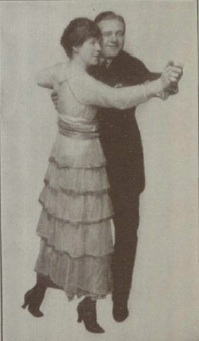
    Dancer Joan Sawyer, owner of the Persian Gardens nightclub in New York City, called this the “drag step”, but unlike the drag or draw steps found in other dances of the late nineteenth and early twentieth centuries, the feet are not just closed heel to heel.  Instead, the closing foot is tucked behind (his) or in front of (hers) the other.  Here’s Sawyer’s description of the drag step and the following “trot”, with the accompanying illustration at left:

    The gentleman slides the left foot out to his left as though he were going to walk sideways.  He then drags his right foot over back of the heel of the left foot, coming up slightly on the toes at the end of the movement, and breaks into a forward “trot” of four steps, gentleman starting the first trot step with is left foot…The lady you see slides her right foot out to her right, she then points the toe of her left foot over in front of her right foot, throwing her weight on to the left foot, then trots backward four steps, sliding the right foot back first.

    (more…)
  • A Valentine Cotillion

    I return once more, in honor of Valentine’s Day, to H. Layton Walker’s delightful Twentieth Century Cotillion Figures (Two Step Publishing Company, Buffalo, New York, 1912), which is always guaranteed to provide me some interesting figures for imaginative dancers.  Christmas was a bit disappointing, as holiday cotillion themes go.  Valentine’s Day seems much more promising, since both cotillions and valentines have the goal of matching up people and thus ought to combine nicely!

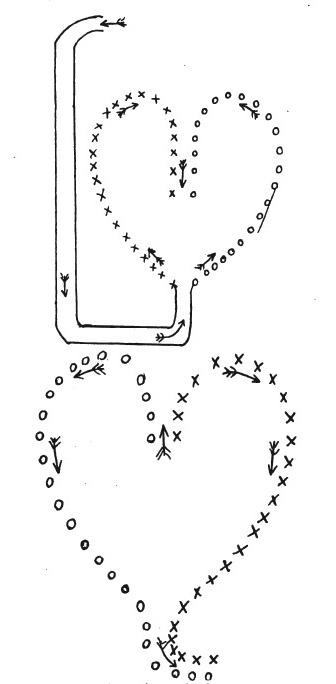
    Starting from the top of an evening’s program, Walker does provide a couple of useful suggestions for the grand march.  I noted a few years ago that good leaders could get their marching dancers into formations such as the letters of the alphabet, or other geometric figures.  Hearts, for example, lend themselves easily to being both created and escaped from by lines of dancers.  Walker provided the diagrams at left for what he called a “Heart March Cotillion”, though the shape is so basic that one hardly needs the help.

    (more…)