Author: Susan de Guardiola

  • Late Victorian Waltz Variations: Fascination

    Fascination is another of the myriad minor waltz variations given by dancing master M. B. Gilbert, in his Round Dancing (Portland, Maine, 1890), who includes the dance “by permission of D. B. Brenneke”, presumably the creator.  It is essentially a longer and slightly more complex elaboration on the Gavotte Glide.

    Gilbert’s description reads:

    First Part:–Slide left foot to side (2d), 1, 2; draw right to left, placing weight on right, 3; one measure. Repeat one measure. Slide left to side, 1, 2; draw right to left and slide left to side (chassé), & 3; one measures. Draw right to left and slide left to side, & 1, 3; draw right to left, placing weight on right. 3; one measure.

    Second Part:–Waltz four measures. Recommence at first part.

    Counterpart for lady.

    The dancers are in standard waltz position, the gentleman facing the wall.  The lady dances the same moves on opposite feet.

    (more…)

  • La Russe

    (Note 6/3/24: I’ve written a follow-up to this post; the link is at the end.  My reconstruction stands.)

    I picked La Russe out some time ago while looking for easy late nineteenth century waltz-time variations.  The name means “the Russian woman”, and I recently had the pleasure of teaching it in Moscow to a very talented group of Russian dancers.

    No specific choreographer is known for La Russe, but we can date it with unusual precision to just over 130 years ago.  Dancing master M. B. Gilbert, in his Round Dancing (Portland, Maine, 1890), noted that it was “introduced by the American Society of Professors of Dancing, New York, May 1st, 1882,” and it turns up in a couple of other American dance manuals of the 1880s.  All the descriptions are quite consistent, though the terminology used varies.

    (more…)

  • Late 19th Century Jig-Time Dances: The Bronco

    Like the Rockaway, the Bronco is another dance listed under the “Miscellaneous” category in M.B. Gilbert’s Round Dancing (Portland, Maine, 1890) as suitable for either jig time (6/8) or galop time (2/4). 

    Please see my earlier post on the Rockaway for a discussion of jig and galop rhythms and a sample of jig music.

    Original description

    Leap backward from the right to left foot, 1; leap backward upon the right foot, 2; leap backward upon the left, 3; pass right to side and immediately draw left to right (à la Newport), & 4; pass right to side and draw left to right, & 5; leap forward upon the right, 6; pass left to side and draw right to left, & 7; pass left to side and draw right to left, & 8; four measures.  Repeat, commencing as at first. The second time the right foot may move backward at the sixth count, making the turn to the left.  Counterpart for lady.
            —  Gilbert, Round Dancing, p.165

    (more…)

  • Late 19th Century Jig-Time Dances: The Rockaway

    I’ve recently been looking more closely at some of the “Miscellaneous Dances” found in the back of M. B. Gilbert’s 1890 tome, Round Dancing, and noticed that quite a few of the dances there are labeled specifically as for dancing to jig time (6/8) or for either jig or galop (2/4) time.  The Rockaway is one of those given as suited for either time signature.

    The earliest source I have for this dance is a New York dance manual, and it seems likely that it was named for the Rockaway Peninsula, a part of Long Island which was a popular seaside resort area in the nineteenth century.  The description in Gilbert is considerably clearer and is the basis for this reconstruction.

    (more…)

  • May 2012 Gig Calendar

    I started out May in the wonderful city of Moscow, teaching nineteenth century dance at Anno Domini, and have a burst of events in the first half of the month before things quiet down substantially.  I may add a few more events later this month, but for now, here's the calendar:

    (more…)

  • April 2012 Gig Calendar

    April is a relatively quiet month as I prepare for my trip to Russia at the end of it, but I have a few things going on, with four consecutive trips to Massachusetts!

    Here's a quick list with links for more information:

    (more…)

  • CD Review: Returning Heroes

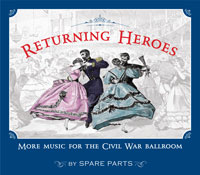
    Brand new this month — the release party is coming up in a couple of weeks — is the dance band Spare Parts‘ latest CD of mid-nineteenth-century dance music, Returning Heroes.  After dancing for many years to music from their earlier CD, The Civil War Ballroom, it’s a delight to have new music for this era!

    The short review: it’s a great CD; buy it immediately if you enjoy dancing of the Civil War era.

    The longer version follows.

    Disclaimer: the musicians of Spare Parts are personal friends, and my advance copy of this CD was sent to me as a gift.

    (more…)

  • March 2012 Gig Calendar

    I have a wide variety of gigs this month; everything from Regency dancing to hoopdance, plus another fabulous Victorian Ball, this time an 1880s-style Fancy Dress event!

    I am also available for private lessons in Connecticut (New Haven or Middletown) generally, and occasionally in New York City and elsewhere.

    Here's a quick list with links for more information:

    (more…)

  • Renoir’s “Dance” paintings at the Frick

    A quick note to let people in the New York City area know about a new exhibition at the Frick Collection:

    (more…)

  • February 2012 Gig Calendar

    Most of my major gigs are concentrated the first and last weekend of February, but I have a few Connecticut ones in between!

    I am also available for private lessons in Connecticut (New Haven or Middletown) generally, and in New York City and the Boston area on specific dates.

    Here's a quick list with links for more information:

    (more…)

  • Down East Breakdown

    • Era: late 1850s-1860s, America (New England)

    Down East Breakdown is an unusual Civil War-era American contra dance: unlike most of them, it is done in “mescolanze,” or four-facing-four, formation.  I have directions for it only in two manuals by Boston musician Elias Howe: Howe’s Complete Ballroom Handbook (Boston, 1858), and American Dancing Master and Ball-Room Prompter (Boston, 1862).  Unlike many contra dances of the mid-century, it does not seem to have been picked up by later writers.

    The name of the dance is rather interesting.  “Down east,” in a New England context, refers to eastern Maine.  A “breakdown” in this era was a type of solo dance, like clogging, which was particularly associated with slave dancing and minstrelsy, as may be seen in works like Jig, Clog, and Breakdown Dancing Made Easy (New York, 1873).  An illustration at the American Antiquarian Society website, taken from the January 31, 1863, edition of Frank Leslie’s Illustrated Newspaper, shows “contraband children” dancing a breakdown.  The dance itself does not incorporate any kind of stepping or anything other than perfectly typical figures, however.

    (more…)

  • January 2012 Gig Calendar

    I have lots of dance workshops and events scheduled this month to start the new year off right — see the list below.

    I am also available for private lessons in Connecticut (New Haven or Middletown) generally, and in New York City and the Boston area on specific dates.

    Here's a quick list with links for more information:

    (more…)

  • Bricklayer’s Hornpipe

    • Era: 1850s-1890s, America (New England)

    Here’s an easy American contra dance of the Civil War era found in three Boston sources.  Two are manuals by Elias Howe: Howe’s Complete Ballroom Handbook (Boston, 1858), and American Dancing Master and Ball-Room Prompter (Boston, 1862); the third is Professor L.H. Elmwell’s Prompter’s Pocket Instruction Book (Boston, 1892).

    The figures for the dance, as given by Elmwell:

    First couple cross over inside below second couple (4); Up on the outside and turn partners to places (4); First couple down the centre, back and cast off (8); First lady swing second gent (4); First gent swing second lady (4); Right and left (8).

    The earlier instructions from the two manuals by Howe are virtually identical except that he describes the second move as “up on the outside swing partner to place”, a distinction I will address below, and the swings of the first lady/second gentleman and first gentleman/second lady as “quite round”.

    (more…)

  • December 2011 Gig Calendar

    I have a bunch of small events and workshops this month before I take my brief winter break.  This is a particularly good month if you want to enjoy some waltzing — I have waltz events in New York, Connecticut, and Boston!

    I am also available for private lessons in Connecticut (New Haven or Middletown) generally, and in New York and the Boston area on specific dates.

    Here's a quick list with links for more information:

    (more…)

  • Harvest Home

    • Era: American, late 1850s-early 1860s

    In commemoration of the American Thanksgiving holiday, here’s a seasonally appropriate dance from the American Civil War era, a country dance for a set of six couples.

    While I have not done a comprehensive search, I appear to have instructions for “Harvest Home” only in a pair of dance manuals by Elias Howe: Howe’s Complete Ballroom Handbook (Boston, 1858) and American Dancing Master and Ball-Room Prompter (Boston, 1862), which include far more country dances than is typical of other dance manuals of the time period.  New England to this day retains a stronger country dance tradition, in the form of modern contra dance, than most other parts of the United States.

    (more…)
  • Right & left: hands or not?

    By the mid-nineteenth century, the only American dance manuals that contain large quantities of contradances are those from the New England area.  Others may have a few here and there, but not the pages and pages of them, or entire manuals of nothing but contras.  And, alas for reconstructors looking back 150 years later, the authors simply don’t bother to explain how to do specific figures.  Presumably, everyone knew.

    For most figures this isn’t a particular problem; they’re self-evident from the name or unchanged from earlier eras.  But there is one figure that is especially ambiguous to dance historians, and that is “right and left” or “rights and lefts”.  The major reason for the ambiguity is good old Thomas Wilson, a dancing master in early nineteenth-century London and a prolific author.  Wilson wrote some of the most useful books on English country dance in all of dance history, with explanations, diagrams, and occasionally even steps for each figure.  But he had a somewhat unusual take on right and left.

    (more…)

  • Gothic Ancestry: A Country Dance Gallopade

    • Era: 1830s, England

    A year or so ago I published a discussion and reconstruction of the 1862 country dance gallopade known as The Gothic Dance and mentioned that there was a very similar dance in London dancing master J. S. Pollock’s c1830 manual, A Companion to La Terpsichore Moderne (Second Edition).  I’ve taught this dance at the few 1830s events I’ve had an opportunity to run, but have not previously published a reconstruction.

    The original instructions for the dance, one of a pair of country dance gallopades with numbers but no titles, are as follows:

    No. 2.     (4 parts) 

        All advance, retire, and cross over, changing places with partners — advance, retire, and cross over back again — first and second couples right and left — first couple gallopade down the middle to the bottom of the dance, and remain at the bottom.

    (more…)

  • Connecticut Workshops (August, 2011)

    I’m going to be teaching five workshops in August at Vinnie’s Jump & Jive covering an interesting mix of early nineteenth century dance and twentieth century line dancing, as well as cross-step waltz.  Details are below.  No advance registration is necessary for any of these — just show up at Vinnie’s.

    (more…)

  • Star Schottische

    One of the myriad minor schottische variations described in M.B. Gilbert’s Round Dancing (1890), is notable as the earliest appearance I’ve noticed of what has become the standard style for the first part of modern folk schottische: three running steps forward in “military position” (as described in my previous post, “À la Militaire“) rather than the step-close-step of the nineteenth century dance.

    Gilbert attributes the Star Schottische to W.F. Mittman.

    (more…)

  • The Original Gallopade

    Like the Royal Gallopade, which I discussed here, the Original Gallopade was published in the Companion to La Terpsichore Moderne (Second Edition) by J. S. Pollock (London, c1830) and is a specific choreography that combines galop round the room, short quadrille-like figures, and a final sauteuse waltz.  I’m not sure about the original part; I suspect that the original form of gallopade was nothing but galop.  But that’s the title Pollock published it under.

    Here is the general description of the dance, as given by Pollock:

    La Gallopade may be danced with an unlimited number of persons, standing circularly in couples, following each other round the room.  In the first figure, the gent. passes his right arm round the waist of the lady, and with his left hand takes hold of the lady’s right, the lady’s left hand resting on the gent’s. right shoulder — the whole of the couples being thus placed, the ladies are all on the outside of the circle.  At the end of the first four bars, the lady crosses to the left of the gent. resting her right hand on the gent’s. left shoulder and holding hands in front as before, which brings the ladies to the inside of the circle.  This figure is performed four times over, and occupies sixteen bar of the tune.  At the fourth time, the whole of the party fall back in a circle, the ladies all standing on the right hand of their partners, ready to commence the figures as they occur.  This dance is performed with a particular and characteristic step, of which it is impossible to give such a description, as would enable any one to dance it, without personal instruction.

    (more…)

  • The English Liked to Waltz

    A telegraph from London updates Americans on the early twentieth-century dance scene in London:

    Waltz Popular in London

        London, Jan. 2. — The lancers, quadrille, polka, and mazurka, once popular dances, have now almost disappeared from the ball programmes of fashionable London.  The American two-step to some extent has taken the place of the polka, but the dance most in favor is the waltz, which, according to an Italian expert, the English people seem to dance like persons in a dream, so slowly is the time usually taken.

        — The New York Times, January 3, 1909

    English dance teachers felt that this state of affairs called for high-level assistance, as a later article alerts New Yorkers:

    (more…)

  • Lowe’s Gallopade Quadrille

    Here’s an easy and interesting quadrille taken from Lowe’s Ball-Conductor and Assembly Guide, Third Edition, published in Edinburgh by the “Messers. Lowe.”  The manual is not dated, but internal references and the type of dances included suggest that it is from the late 1820s or early 1830s.  Given the era, I would expect to dance the figures with early nineteenth century quadrille steps, but the steps and sequences required are few and easy.

    The Gallopade Quadrille, or Quadrille Galope, is for the usual four couples in a square and consists of three figures, each with three parts.  The format of each figure is:

    16b    Galopade
    16b    Various quadrille figures
    16b    Sauteuse

    This gives a length of 48bx3.  Following the third figure, the dancers continue to sauteuse until the end of the music.

    (more…)

  • Go Figure!

    At our recent Regency Assembly, one of the dancers challenged my call of a “half figure eight” in a country dance, asking why it wasn’t called a “figure four”.  Casey, being an experienced dancer, knew exactly why, but he has excellent comic timing, and the comment broke up the room for a moment.

    A geekier question would be why I was using the term “half figure eight” rather than the more typical plain “half figure”.  That was for added clarity for modern dancers, who may not be as familiar with the nuances of Regency terminology, in which a sentence like “The figure of the dance is a double figure made up of five figures, the first being the figure” makes perfect sense.  Since it doesn’t for everyone, let’s figure out all those different usages of “figure”!

    Although every Country Dance is composed of a number of individual Figures, which may consist of “set and change sides,” “whole Figure at top,” “lead down the middle, up again,” “allemande,” “lead through the bottom,” “right and left at top,” &c. yet the whole movement united is called the Figure of the Dance.
    — Thomas Wilson, in The Complete System of English Country Dancing, London, c1815.

    (more…)

  • The Newport

    A new waltz or redowa variation pops up in a few of the manuals of the very late nineteenth century.  Presumably named after the wealthy resort town, the Newport appears in slightly different versions in different manuals, but the common element appears to be a series of quick sliding steps.

    Apparently the Newport was too new to be included in New York dancing master Allen Dodworth’s Dancing and its relations to education and social life  (New York, 1885).  The earliest and clearest description I have found is in M. B. Gilbert’s Round Dancing, published in Portland, Maine, in 1890.  His version, included “by permission of Russ B. Walker,” is essentially an ornamented version of the standard waltz of the late nineteenth century, with two rapid slides to the side rather than one in each bar for a “step-side-close-side-close” sequence rather than the usual “step, side, close.”  A half-turn is made on each bar, just as in the regular late nineteenth-century waltz, with a complete turn every two bars.

    (more…)

  • Le Triangle

    Subtitled Nouveau Quadrille, Le Triangle is not actually a quadrille in the literal sense of a dance involving facing couples.  It was composed by F. Paul and published in his manual, Le Cotillon, in Paris in 1877 and is danced by three couples rather than four, arranged in the form of a triangle.  Paul composed it to address the difficulty of finding four couples for the quadrille croisé of the time.  He adds modestly that he does not intend to impose it upon dancers, but gives the description only as a proposal.  I have never seen Le Triangle in any other source; it may never have been danced outside of Paul’s immediate circles.

    (more…)