Along with my usual monthly classes, this month I'll be calling for a Regency-era ball with an American theme and making a trip down south to teach waltz in North Carolina before making my way slowly back up the east coast. The schedule as it stands now is below. As usual, I add DJ gigs to my schedule somewhat randomly, so check back to see when those appear.
Author: Susan de Guardiola
-
New York, New York
The New York is another of the myriad “redowa and mazurka” variations given in M. B. Gilbert’s Round Dancing (Portland, Maine, 1890). Along with the Fascination, it is one of only a few variations credited to Indianapolis dancing master D. B. Brenneke. It reappears among the material translated directly from Gilbert in [George] Washington Lopp’s La Danse (Paris, 1903), where it is listed as a mazurka and again credited to Brenneke.
Gilbert gives both this “New York” and another dance called “The New York”, making it unclear whether the name refers to the city or whether it is simply a new version of the York. Lopp lists it as La New York, along with two different dances called La Nouvelle York. Lopp’s translations suggest that the reference is to the city as much as to the popular dance. That might make it something of a pun, since the New York does include the characteristic sliding sequence found in the first measure of the York.
-
The Independent York
The Independent York is an interesting variation on the original York, albeit one that was probably rarely danced outside a studio context. I have found it in only two sources. The earlier is Melvin Gilbert’s Round Dancing (Portland, Maine, 1890), where it is uncredited, suggesting that Gilbert himself created it. The later source is La Danse, by [George] Washington Lopp, published in Paris in 1903, much of which is simply a French translation of Gilbert. It appears there as L’Indépendant York and is credited to Gilbert. The sequence is identical in both sources. Gilbert classifies it, as he does the York, under “redowa and mazurka”; Lopp lists it as a mazurka.
-
April 2013 Gig Calendar
April will be a crazy travel month for me, flitting between Connecticut, Massachusetts, and New York repeatedly over the course of the month. The schedule as it stands now is below. I tend to add DJ gigs to my schedule at the relative last minute, so check back to see when those appear.
-
March 2013 Gig Calendar
March is going to be a very quiet month for me. I'm clearing my calendar of most outside gigs for the last couple of weeks of the month to work on some writing and reviewing projects.
I tend to add DJ gigs to my schedule at the relative last minute, so check back to see when those appear!
-
Chassé-Croisé Sequences for Regency-Era Quadrilles (3 of 3)
(This is the third and final post in a mini-series covering Regency-era step-sequences for the quadrille figure chassé-croisé. Previous posts are here (with a general introduction) and here.)
My third and (so far) final sequence for an eight-bar chassé-croisé comes from Elements and Principles of the Art of Dancing, a translation of J. H. Gourdoux published by Victor Guillou in Philadelphia in 1817. The translation, presumably of the 1811 Principes et Notions Élémentaires sur l’Art de la Danse Pour la Ville, is inconsistent in how closely it hews to Gourdoux’s original. This step sequence for chassé-croisé does not appear in the 1811 manual at all and may have originated with Guillou himself.
Even more than Gourdoux’s own sequence, this one features different footwork for the gentlemen and the ladies.
-
Chassé-Croisé Sequences for Regency-Era Quadrilles (2 of 3)
(This is the second post in a mini-series covering Regency-era step-sequences for the quadrille figure chassé-croisé. See the first post for a general introduction to the figure.)
My second sequence for chassé-croisé actually comes from a French source, the second edition of Principes et Notions Élémentaires sur l’Art de la Danse Pour la Ville (Paris, 1811) by J. H. Gourdoux. The same sequence reappears in his later manual, De l’Art de la Danse (Paris, 1823). It is similar to the Strathy sequence described in my previous post, but the differences are quite intriguing.
I won't cover steps in this post, since I just summarized them in the previous one and no additional ones are required for Gourdoux's sequence.
-
Chassé-Croisé Sequences for Regency-Era Quadrilles (1 of 3)
By far the most common sequence variations to be found in quadrille manuals of the early nineteenth century are those for setting, forward and back, chassez-dechassez, and crossing over. But a few manuals give sequences for more elaborate figures such as chassé-croisé, in which two dancers, side by side, change places and back. There are quite a few ways to perform the figure, but the most common is probably that danced with one’s partner in eight bars as follows:
2b Change places, gentlemen passing behind ladies
2b Set
2b Change back, gentlemen again passing behind ladies
2b SetThis can be performed just by two couples (heads or sides) or by all four at once, as in the classic Finale figure of the first set of French quadrilles.
-
Hollywood Line Hustle
It’s been quite some time since I did any disco line dances, but here’s one for the folks who love these session at the Dance Flurry. Sadly, I’m not teaching there this year, but you can do this one on your own!
Unusually for one of these dances, I actually have it in two different sources: The Complete Book on Disco and Ballroom Dancing
(1979) (paid link) by Ann T. Kilbride and A. Algoso, and The Complete Guide to Disco Dancing
(1978) (paid link) by Karen Lustgarten. The sequence is almost exactly the same in both books. Kilbride and Algoso mention alternate names: the L.A. Line Dance or L.A. Line Hustle and note that it was popular in a particular area of the country, presumably southern Califoria. Lustgarten calls it “one of the most popular line dances” and suggests disco hits to dance it to: Boz Skaggs’ “Lowdown
” (paid link) for a slow version, and Vickie Sue Robinson’s “Turn The Beat Around
” (paid link) for a faster one.
-
Alternating racket waltz patterns
- Era: 1880s into very early 1900s
The last of the racket waltz patterns appears only in Allen Dodworth’s Dancing and its Relation to Education and Social Life (New York, 1885, reprinted 1900) and is thus saddled with his prosaic yet unwieldy title, “Alternating One Slide and Three Slide to Waltz.” That’s more a description of the technique a name, but it’s what we’ve got.
Unlike “Alternating the One Slide and Three Slide to Galop,” more usually known simply as the racket, the waltz-time version does not just combine the two existing racket waltzes (one-slide and two-slide) in a short/short/long short/short/long pattern. That works in waltz time since both the “short” and “long” patterns take only one measure apiece. Instead, this racket actually uses a three-slide racket, as in galop time, stretched in an irregular way from four beats to six, similarly to how the one-slide racket in galop is stretched from two beats to three in waltz time…but more complicated.
-
Run, run…a redowa!
To be perfectly specific, that’s a polka redowa, a polka step in slow waltz time. This variation for it, called The Run, was, as far as I can tell, unique to the fifth edition (1892) of William B. De Garmo’s The Dance of Society.
The sequence is simplicity itself:
- In normal closed position, dance polka redowa, turning (six measures)
- Release hands and open up into “military” position, side by side (as described and shown here).
- Run forward six steps (two measures)
- Join hands again to repeat from the start
-
February 2013 Gig Calendar
I’m staying warm this winter with lots of travel and dance, including our first Connecticut Regency tea dance and DJ gigs in three cities! I’m still adding gigs, but here’s the February schedule so far:
Edited to add: note that my February 10th & 12th Regency events in Connecticut have been moved to February 17th & 26th, respectively, due to the enormous snowstorm of February 8-9th.
-
Mr. Scott’s Two-Step
The two-step of the 1890s and early 1900s was so simple to dance, and so aggressively condemned by many dancing masters, that it’s actually fairly unusual to find a good description of it in a dance manual, though minor variations and sequences of dubious originality and debatable utility abound. English dancing master Edward Scott, in How to dance and guide to the ball-room (London, c1902), provides a rare overview of the basic dance as performed in Edwardian England.
Steps and timing
Scott specifies that the music for the two-step should be in 6/8, and explains that it is “practically our old friend the galop performed with figures, in regulated sequences, and to a different rhythm,” though Americans, he claims, apply the name two-step to “any dance founded on the chassé movement, or that in which one foot appears to be chasing the other.” -
January 2013 Gig Calendar
Happy new year! I'm back on the road again in New York, Connecticut, and Boston this month after my holiday break:
-
Simonet’s Parisian Quadrilles, Third Set, c1820
There are many, many sets of early nineteenth-century quadrilles, most of which are simply new music for the First Set or include only minor variations on the standard figures. While I don’t normally publish reconstructions of the figures for random sets of quadrille music, this set is of particular interest because a high-quality recording of it is available on The Regency Ballroom CD by Spare Parts.
The music is from the first series of T. Simonet’s Fashionable Parisian Quadrilles, Performed by the Bands of Messrs. Michau, Musard and Collinet, with their appropriate Figures as danced at Almack’s, the Argyll Rooms and at the Bath & Cheltenham Assemblies. The manual is undated, but in February, 1823, the fashionable magazine La Belle Assemblée reported the publication of “Nos. 42 and 43” of the series, commenting positively:
This is really an elegant little work both in its contents and its typography. We recognize many of the quadrilles as being great favorites in the French metropolis, and the whole of them are composed in a very characteristic and original style.
-
Mr. Fezziwig’s Ball
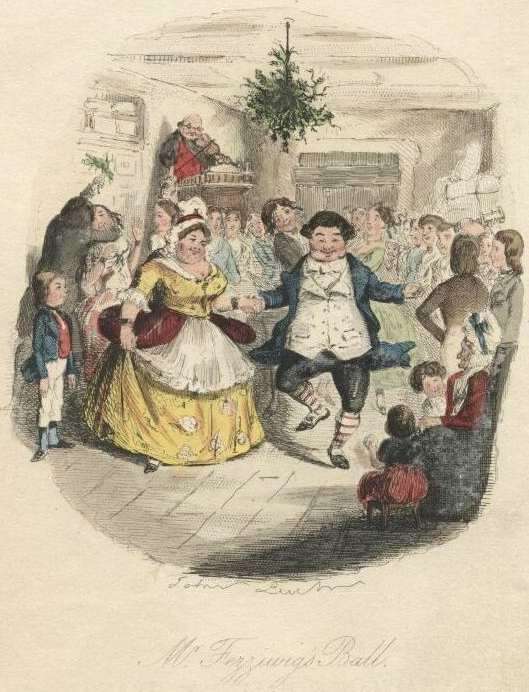 “In came a fiddler with a music-book, and went up to the lofty desk, and made an orchestra of it, and tuned like fifty stomach-aches.”
So begins the famous description of Mr. Fezziwig’s Christmas Eve ball in Charles Dickens’ 1843 novel, A Christmas Carol, the full text of which with the original illustrations, including the one shown at left (click to enlarge), may be found at Project Gutenberg.
This is a fun example of, at least, a Victorian writer’s conception of a late 18th century ball which, though given by a successful businessman, is very much of the middle and lower classes rather than of the nobility. Given that Dickens’ family was not wealthy (at one point they ended up in a debtors’ prison), he may have been writing more from personal experience in London in the 1830s than, say, careful research about ballroom practices several decades earlier. So while this is a useful historical document for dance history, which period it is useful for is not entirely clear.
-
December 2012 Gig Calendar
Things are calming down for the end of the year here! Just a few gigs this month, though I'm still happy to give private lessons betwixt and between:
-
Late 19th Century Jig-Time Dances: The Pasadena
The Pasadena, a would-be replacement for the two-step, appears in the 1900 reprint of New York dancing master Allen Dodworth’s 1885 tome, Dancing and its relations to education and social life, but can be dated back to at least 1898. It appears to have been created as a dancing school dance, as Dodworth’s nephew, T. George Dodworth, discussed in his introduction to the new edition of his uncle’s manual:
In order to bring the work up to date, I have been requested
to write an introduction which will include a list of dances that have come into fashion since my uncle’s book was originally published.
As a matter of fact, however, society dances have decreased, rather than increased, during this interval. When this work first appeared most of the round dances described in its pages were fashionable. But Dame Fashion is fickle, and, owing to some unaccountable change in taste, we now have only the Two Step, the Waltz, occasionally a Saratoga Lancers, and the Cotillion. In the dancing-schools the old dances are still taught, but with numerous new combinations, which are composed to improve the pupil and keep alive the interest. From these combinations we have the Tuxedo Lancers, the Amsterdam, Gavotte der Kaiserin, Minuet de la Cour (for four persons), and the Pasedena. -
November 2012 Gig Calendar
This is going to be a wild month of travel for me, starting off in beautiful Saint Petersburg, Russia, then ricocheting up and down the northeastern United States for a few weeks:
-
Galop à Trois Pas (Three-Slide Galop)
Known variously as the three-slide galop, three step galop, galop à trois pas, or galop à trois temps, this late-nineteenth-century variation is simply the standard galop step migrated into waltz time. I’ve previously discussed the galop in 2/4 time in detail; the three-slide version is the same kind of series of slides and “chasing” steps:
1b Slide-close-slide-close-slide = 1 & 2 & 3
2b Slide-close-slide-close-slide = 1 & 2 & 3This could also be described as slide-chassé-chassé, with each chassé being a “close-slide”.
As is standard for galop, the first half is performed leading with the first foot (gentleman’s left, lady’s right) with the second foot then closing behind in order to again slide with the first foot. The second half is then performed by sliding with the second foot and closing with the first. As with the 2/4-time galop, no hop is mentioned.
-
October 2012 Gig Calendar
October is when life gets crazy again, with a weekend in New York City, several days in Boston, the tenth Regency Assembly mid-month, and heading off to beautiful Санкт-Петербург at the end!
-
September 2012 Gig Calendar
I’m on the road through early September, and then after a little flurry of gigs in the middle of the month, spending a couple of quiet weeks catching up after five weeks of near-constant travel. Here are the gigs open to the public:
-
August 2012 Gig Calendar (plus a bit of September!)
I'm going to be on the road for the last half of August and part of September, so no blues DJing this month and no extra time in Boston or New York City, but lots of chances for private lessons in places I'm not usually in!
-
Howe’s “Rats” Quadrille, concluded (3 of 3)
This is the third in a series of three posts discussing the “Rats” Quadrille, with this one covering the fourth and fifth figures. See the two previous posts for introduction and background and the first three figures.
-
Howe’s “Rats” Quadrille, continued (2 of 3)
On to the actual figures of Howe’s “Rats” Quadrille! Please see the first post in the “Rats” series for an introduction to the quadrille and links to sheet music.