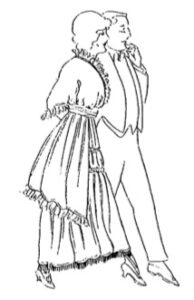
Mixer dances, where all the participants shift partners at intervals, are useful icebreakers at dance events. In A Complete Practical Guide to Modern Society Dancing (1903), Philadelphia dancing master Albert W. Newman offers a simple mixer for use with the then-fashionable two-step, asserting hopefully that
This dance is rapidly gaining popularity, as it is most enjoyable.
The dancers take partners and hold hands in a grand circle, with each gentleman standing to the left of his partner, and all circle to the left (clockwise). The dance leader calls out a number (3, 7, 12, etc.), and all the dancers face their partners and begin a grand chain, giving right hands to their partners and pulling by, left to the next, right to the next, left to the next, etc. As they move, they count people, starting with their partners as “one.” When they reach the number called out by the leader, each takes ballroom position with that person and two-step until the leader gives a signal (typically a whistle), at which point all the dancers open up into a grand circle and once again circle to the left.
(more…)

 (paid link). I like to wait out the intro and start at the “do the hustle!” verbal cue. But as usual with line dances, the Line Hustle will also work to just about any disco tune.