Author: Susan de Guardiola

  • The Nahant Quadrilles (1 of 4)

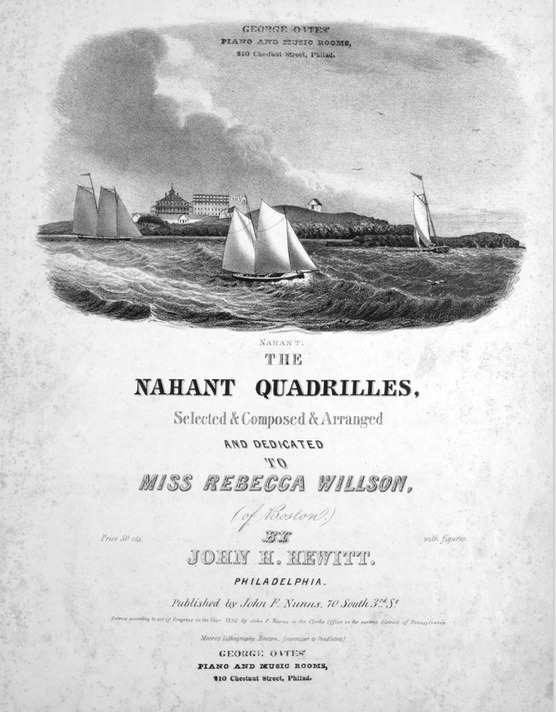
    At left is the cover of The Nahant Quadrilles, published in Philadelphia in 1836 but named after the resort town of Nahant, located on a peninsula near Boston and seen in the background of the cover image (click to enlarge).  For many years, Nahant has been the home of a summer 1860s ball hosted by Nahant resident and Vintage Victorian proprietor Katy Bishop and her late husband Ben.  The Nahant Quadrilles were first worked on for these balls by the Bishops and my own late mentor, Patri Pugliese, in a style befitting the 1860s milieu in which they were used.  Patri was a stickler in his approach to dance reconstruction and dubbed his version a “choreography” because of the degree of adaptation.

    I’ve long had my own reconstruction of this set tucked away, and since the Nahant ball (lately expanded to a full weekend) is canceled due to Covid, this seems an opportune moment to publish it and compare the different approaches.

    (more…)

  • Early Foxtrot: The Minuet Turn

    Keeping with the foxtrot theme, here's one more little sequence for foxtrot or one-step from Edna Stuart Lee's Thirty Fox Trot Steps (New York, 1916).  Despite its overt simplicity, it actually manages to present a minor reconstruction issue!  As for the name…well, to be perfectly honest, I see absolutely no connection here to the minuet, any more than I do with Newman's Minuet Tango.  There seems to have been some concept of "minuet" in the 1910s which I have completely failed to grasp.

    The gentleman's steps are given; the lady dances opposite.  The dancers begin in normal ballroom hold, the gentleman facing forward along line of dance and the lady backward.

    (more…)

  • Early Foxtrot: The Pavlowa Extension

    For no reason other than habit, June is always foxtrot month for me, and despite the general shutdown of dance classes, I’m lucky enough to have a convenient partner at hand for experimentation with new variations.  So let’s look at yet another of the many step-sequences described in Edna Stuart Lee’s Thirty Fox Trot Steps (New York, 1916)!

    The Pavlowa Extension was, of course, named for the famous ballerina Anna Pavlowa (Pavlova), who toured America in the mid-1910s and dipped into social dance choreography with a music-composition contest resulting in a trio of dances published in The Ladies’ Home Journal in early 1915.  She (or her ghostwriter) and (supposedly) members of her troupe also offered opinions and suggestions about dancing the one-step, Boston, and foxtrot.  This variation, however, is not among those even indirectly associated with Pavlova.  It probably was merely named in her honor, or perhaps was inspired by a characteristic movement in her dancing.

    (more…)

  • Leap Year Cotillion Figure

    For a change of pace, here’s a leap year-themed cotillion (dance party game) figure from H. Layton Walker’s  Twentieth Century Cotillion Figures (Two Step Publishing Company, Buffalo, New York, 1912).  I think the only “leap year” element in it is that the ladies pursue the gentlemen, rather than the reverse.

    Here’s the original text:

    LEAP YEAR FIGURE
    For this figure you will require one more gentleman than you do ladies.  An extra man is required to put on a paper shroud.  This figure can be used for any number of couples, but it is always necessary to have an extra gentleman up.  Couples up and dance.  When they have danced a little while, form a circle, and grand right and left, the leader getting into the circle and when all dance the leader must secure one of the ladies.  This will leave one of the gents out.  He is “It,” and goes to the centre to receive this paper suit.  The ladies all receive a large ring having a tissue covering over it.  Get another lady who is not in the figure, so that you will also have an odd lady up.  She also receives one of the hoops.  Now ask the ladies to catch a man.  As there are not enough men for all the ladies the one who does not succeed in getting a man will have to contend [sic] herself by dancing with the dummy.

    It took me a moment to sort this out because of how badly written the instructions are.  The first three sentences can be ignored.  Here’s how it works:

    (more…)

  • A Leap Year Ball, Providence, 1892

    Moving from the American frontier back to the east coast and into increasingly amusing descriptions of leap year events, here’s a very upscale event held in Providence, Rhode Island, on Monday, February 29, 1892, and reported in The Providence News on Tuesday, March 1.  This was a much more glittering affair than the frontier balls in Montana and Wyoming.  According to the article, subscriptions to the ball cost $25 for eight invitations, and the German (cotillion) favors cost an estimated $900.  In today’s terms, that is around $700 for the tickets and an eye-popping $25,000 for the favors, which were always an opportunity for conspicuous consumption among upper-class society.

    The ball was held at the brand-new Trocadero (1891), which, according to Providence’s inventory in 1980 for the National Register of Historic Places, was a restaurant and dancing parlor owned by local businessman Lloyd Tillinghast, who also provided the ball supper, served on “small and beautifully decked tables” by waiters brought in from Boston and New York.  The Trocadero no longer stands, alas.  Two bands were engaged: Reeves’ Band and the “Hungarian band of New York”, who alternated playing.

    (more…)

  • A Leap Year Ball, Wyoming, 1888

    Continuing to roam around the late nineteenth century American frontier, where a surprising number of newspaper descriptions of leap year balls originate, here are some excerpts from a burbling account of a ball in the small town of Douglas, Wyoming.  Like Sun River, it was founded in 1867 and was probably extremely small.  The 1890 Wyoming census recorded only 2,988 people in all of Converse County.  The ball was described on page five of Bill Barlow’s Budget on Wednesday, February 8, 1888, as having taken place the previous Friday evening.  The newspaper title is interesting; more about the paper and its colorful founder, Merris C. Barrow, may be found at the Wyoming Historical Society’s Wyohistory site.

    The ball was held at the Douglas opera house and was described as “the most successful and enjoyable affair of its kind in the history of Douglas.”  Balls are generally described in newspapers as successful unless some sort of disaster occurs, but in a town whose history stretched back only two decades, it might actually have been true.

    (more…)

  • February 2020 Gig Calendar

    I'm having a ball!  Literally, a ball!  In Moscow!  In Russian and English!  Mixing all sorts of crazy dancing together!

    I'll be doing other things this month too, but holding a ball in Moscow is something I've wanted to do for years, so I'm dipping my toe in with a small, beginner-friendly event.  Details and links to the ball prep classes will appear later in the month – check back for updates! 

    (more…)

  • January 2020 Gig Calendar

    Happy new year!  January is going to be a tough month, as I'm having to move to a new flat, which is a challenging task in Moscow.  But I'll still have a few events here and there!  Hopefully normal life will return in February!

    (more…)

  • A shorter Victorian “Sir Roger de Coverley”

    Over the twelve years I’ve been writing Kickery, I’ve twice discussed versions of Sir Roger de Coverley, the English “finishing dance” that was the direct ancestor of America’s Virginia Reel: a Regency-era version from Thomas Wilson and a Victorian-era version probably originated by Mrs. Nicholas Henderson.  The latter version of the dance, which shortened the figures and added an introductory figure for all the dancers, appeared in several English sources from around 1850 to 1870.  But it was not the only version in mid-nineteenth century England; at least two variations of a full version more like the Regency one continued to appear in dance manuals, and a fourth version, shortened even further, turned up occasionally as well.

    The dance being strongly associated with Christmas due to its appearance at Mr. Fezziwig’s ball in Charles Dickens’ 1843 novel, A Christmas Carol, Christmas Eve seems an appropriate time to discuss this extremely short version.
    (more…)

  • December 2019 Gig Calendar

    December will be a quite month of hibernation, research, and private lessons and classes.  The dance series at the American Center at the U. S. Embassy will continue with one regular dance and a holiday party!

    (more…)

  • November 2019 Gig Calendar

    I'll be juggling two big trips in November – to Kyiv, Ukraine, for a ball and a day of classes, then back to the USA in November for the Remembrance Day Weekend balls and a country dance evening in Chicago!  In Moscow, I'll be continuing some private lessons and doing another public dance at the American Center at the U. S. Embassy.

    (more…)

  • A Ballroom Basilisk, 1897

    I'm just going to leave this story here without any commentary.

    Happy Halloween!

    ~~~~~~~~~~~~~~~~~~~~~~~~~~~~~~~~~~~~~~

    GONE WITH A BASILISK.

    A LURID SHORT STORY.

    BY G. L. Calderon

    Reginald passed his hand wearily over his aching brow, and glided languishing between the purple portières.  Within was a chaos of whirling muslin and hungry faces swimming on a sea of passionate, throbbing music.  There was a mist before his eyes; grinning heads floated restlessly by, gibbering in the shell-like ears of painted women.  Amid the fevered maelstrom, one figure loomed large and close upon his attention.  It was the hostess.  A hot wet hand pressed his.  “Law! what a squash!” he murmured in her ear, then plunged into the stream, and was borne away to the other side of the room.

    (more…)

  • Mr. Palmer comes of age, Yarmouth, 1831

    Moving a bit forward in time, the coming of age ball of Mr. Samuel Palmer, junior, on Tuesday, March 1st, 1831, was accorded detailed coverage the following Saturday, March 5th, in The Norfolk Chronicle and Norwich Gazette.  The family seems to have been a prominent one, since they convinced then-Mayor Edmund Preston to lend them a hall and the whole town to deck itself out in celebration of their son's birthday.  And, of course, they were wealthy enough to throw a ball for several hundred guests.  Piecing together public records, I am reasonably certain that the birthday boy's full name was Samuel Thurtell Palmer (c1810-1850), whose parents were probably Samuel and Susanna (Thurtell?) Palmer.

    Most of the article was, as usual, devoted to lengthy lists of guests and their costumes, but there were some interesting tidbits here and there.  The transcriptions below include all of the article with the exception of the lists that just named the attendees and their outfits.

    (more…)

  • October 2019 Gig Calendar

    I am once more happily ensconced in Russia!  I am not launching a full public schedule this month, but I will be experimenting with teaching a short class at the American Center in Moscow (part of the U.S. Embassy); if it goes well, it will become a regular series.  And I may throw a small party at the end of the month – watch this post for updates!  (Edited to add – but I decided not to!  Maybe later in the autumn!)

    (more…)

  • September 2019 Gig Calendar

    One last non-gig calendar for my extended summer vacation!  This month I am moving back to Russia, and starting in October there will once more be classes, parties, and the occasional weekend of travel.  I don't expect any public events this month.  In the meantime, I am still available for private lessons in Connecticut before I leave (though I will be super-busy packing!)  and in Moscow once I arrive.  Email me directly if you would like to schedule a private lesson.

    See you in October!

    (more…)

  • August 2019 Gig Calendar

    I probably should start calling these summer calendars non-gig calendars, since I'm having a quiet summer dance-wise.  I don't have anything planned this month, nor am I planning to change that.  I am still available for private lessons in Connecticut when I'm there.  Email me directly if you would like to schedule a private lesson.

    (more…)

  • July 2019 Gig Calendar

    I am still mostly on my summer reading/research/writing break, but I plan to emerge briefly for my second lecture to the Beau Monde (Regency-focused) subgroup of the Romance Writers of America at their conference in New York in July.  Other events may emerge, but I'm not really seeking them.  Lots of work to do!

    (more…)

  • Early Foxtrot: Quick Dips

    Ah, June, when one turns one's thoughts (and feet) to…weird little foxtrot variations! 

    This time around, let's look at a pair of steps, or rather step-sequences, from Edna Stuart Lee's Thirty Fox Trot Steps (New York, 1916) that both involve quick dips.  These are actually ever-so-slightly harder to do than the usually run of walks, trots, glides, and two-steps that make up a great deal of the 1910s foxtrot repertoire.  Lee noted that the first of these, The Coney Island Dip, is "very exhilarating and excellent exercise for the lungs."

    The gentleman's steps are given; the lady dances opposite.

    (more…)

  • June 2019 Gig Calendar

    I have some personal and research travel planned during June, but otherwise am taking my annual summer reading/research/writing break.  I don't expect (and am not looking for) any public events at all this month.  I am still available for private lessons in Connecticut, or while on my various travels; during the latter, you must provide the dance space.  Email me directly if you would like to schedule a private lesson.

    (more…)

  • The Latest York

    Years ago, when I was working intensely on the “York set” of variations (see here, here, here, here, and here), I somehow skipped The Latest York, possibly because, unlike all those other “Yorks”, it does not feature the characteristic York step sequence of slide-close-slide-cut/close in “1&23” rhythm.

    M. B. Gilbert published The Latest York in his Round Dancing (Portland, Maine, 1890) “by permission of Constantine Carpenter, Son, and Charles C. Martel”.  This style of credit generally refers to the choreographer of the sequence and/or composer of the music.  The same pair are also credited with the Gavotte Glide.  Carpenter is listed in Gilbert’s directory of dancing masters as living in Philadelphia.  Martel is not in Gilbert’s directory, but his name appears in Philadelphia newspapers (The Times, October 21, 1894, e.g.) during the 1890s offering parties and lessons.

    (more…)

  • Rye, just Rye

    Moving right along with late nineteenth-century variations from the usual pair of M. B. Gilbert (Round Dancing, Portland, Maine, 1890) and G. W. Lopp (La Danse, Paris, 1903), here’s a short one that’s classified as a redowa or mazurka.  Lopp attributed La Rye to Gilbert, who had previously printed it in his own work without attribution.  Gilbert did not ever credit himself specifically in his own book, unfortunately, which makes it difficult to be absolutely certain of the attribution.

    The name of the variation suggests that it was meant to be danced to a musical setting of the famous Robert Burns poem, “Comin’ Thro’ the Rye“, which was set in both waltz and schottische rhythms (including both alternately in the Rye Waltz, a sequence dance dating back to at least the 1890s).  The waltz version of the tune, which may be heard on this YouTube video, is not accented like a redowa or mazurka and does not offer especially good musical support to this sequence of steps.  There may have been a version published with a more mazurka- or redowa-like style, but I haven’t been able to locate one.  Skilled musicians might also be able to tweak it musically on the fly.  It’s also possible that there was a completely different tune called “The Rye”, but I actually find this less likely, as the word was so strongly associated with a particular tune.  There was a 1922 novelty dance (“The New Rye Dance”) published which combined a “redowa, Rye movement, and waltz” using “Comin’ Thro’ the Rye”, but that’s much too late to mean anything more than that people really liked adapting “Comin’ Thro’ the Rye” for dancing.

    (more…)

  • Wayside Gavotte

    Just to be thorough, here's a quick reconstruction of the Wayside Gavotte I mentioned in my previous post on the Stephanie Gavotte.  This is another short couple dance sequence, but unlike M. B. Gilbert's Stephanie Gavotte, it moves normally along line of dance throughout and loosely follows a "doubled" schottische pattern with four bars of forward travel and four bars (more-or-less) of turning.  Though it is meant to be danced to "Stéphanie-Gavotte", there is no reason it can't be danced to other schottische music.

    Per Gilbert Dances, Vol. II (1913, Susan Hoffman Gilman, ed.), the Wayside Gavotte was choreographed by Helen C. Way, whom I presume to have been a student of Gilbert's.  It is undated, and since, according to the biography in Gilbert Dances, Vol. I, Gilbert was teaching until his death, it could be from as late as the beginning of 1910.  The use of the waltz-galop step feels to me more reminiscent of the schottische sequences of the 1880s-1890s, however, so I suspect it is from closer to 1900.

    (more…)

  • May 2019 Gig Calendar

    Last month in Moscow!  Along with preparing for my homeward migration at the end of the month, I'll be traveling to Odessa for Vintage Dance Exchange 2019 – By the Sea and teaching a full slate of waltz and nineteenth-century classes and private lessons.

    (more…)

  • Three Tiny Galop Variations

    Wrapping up my impromptu miniseries of posts on galop variations found in M. B. Gilbert’s Round Dancing (Portland, Maine, 1890) and G. W. Lopp’s La Danse (Paris, 1903), here’s a trio of galop variations which I don’t feel warrant sufficient time or analysis for individual posts:

    • Two of the three are short “do something, then some galop” sequences; the other is even shorter and rather dull
    • None of them are very challenging to perform, and two have repeated leaps from a complete stop, which, as a dancer, I don’t really enjoy.
    • None of them have any conflicts between sources.
    • One has a reconstruction problem, but it’s minor and easily resolved.
    • I fully expect that all of them have matching sheet music and that the names of the variations are actually the names of the tunes to which they were choreographed, but I haven’t been able to locate any of it, and none of them are sufficiently attractive to inspire me to spend much time searching.

    So, in the interest of efficiency, here’s the trio together with brief notes about each.

    (more…)

  • The Puritan Waltz (La Puritan Galop)

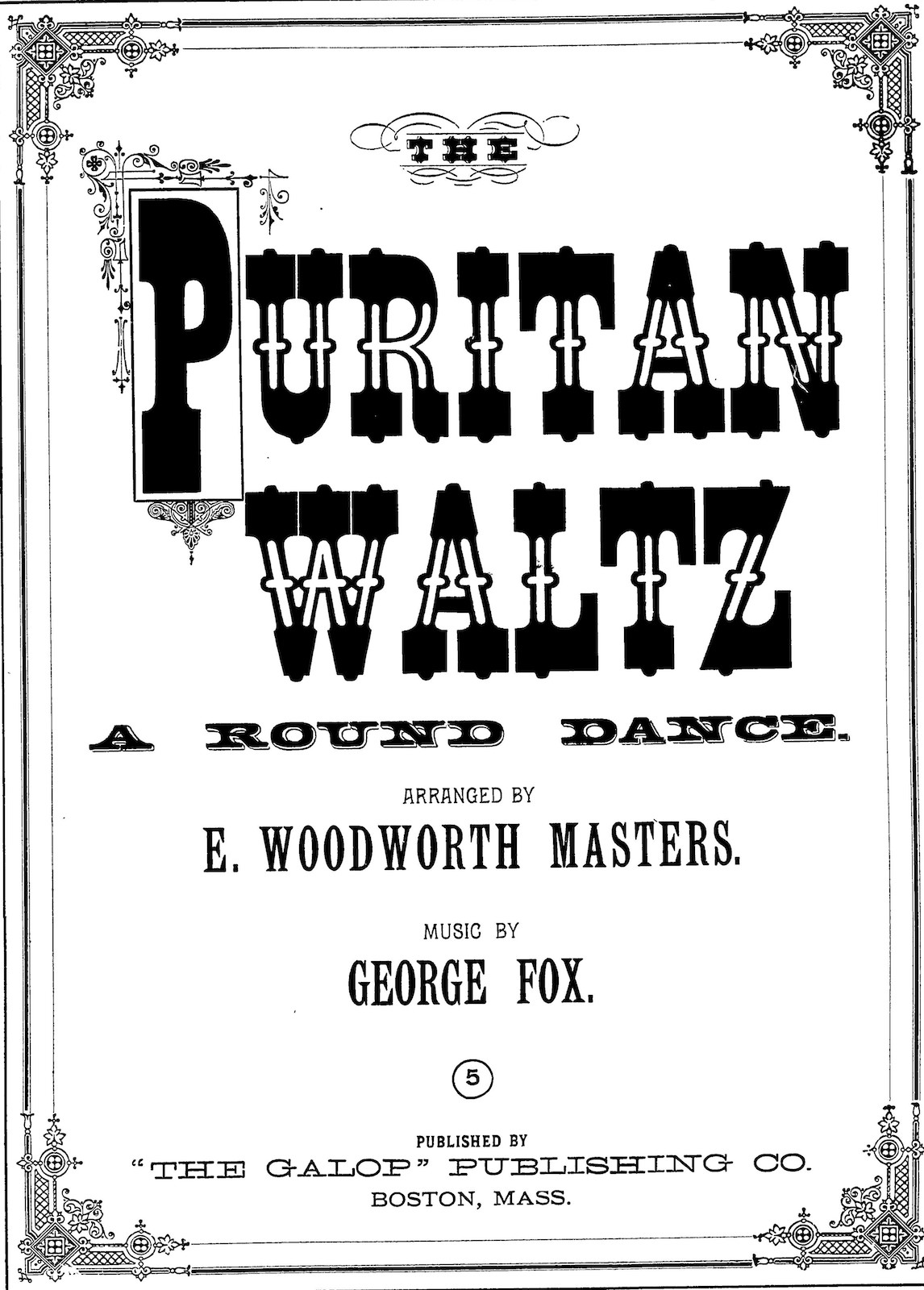
    The Puritan Waltz is not, actually, a waltz.  It’s a galop variation found in both Round Dancing (M. B. Gilbert, Portland, Maine, 1890) and La Danse (G. W. Lopp, Paris, 1903).  Gilbert described it under the name The Puritan Waltz and also referenced it under The Jubilee.  Lopp chose truth in advertising over adherence to the original and went with La Puritan Galop.  The two descriptions match perfectly in the practical aspects, though Gilbert gets a little more poetic in naming the parts of the dance after…a whaling expedition?  I feel like there must be some story behind a dance with parts called “The Calm”, “The Fluke”, and “The Gale”, but I’ve no idea what it might be.  Nantucket Puritans?

    (more…)