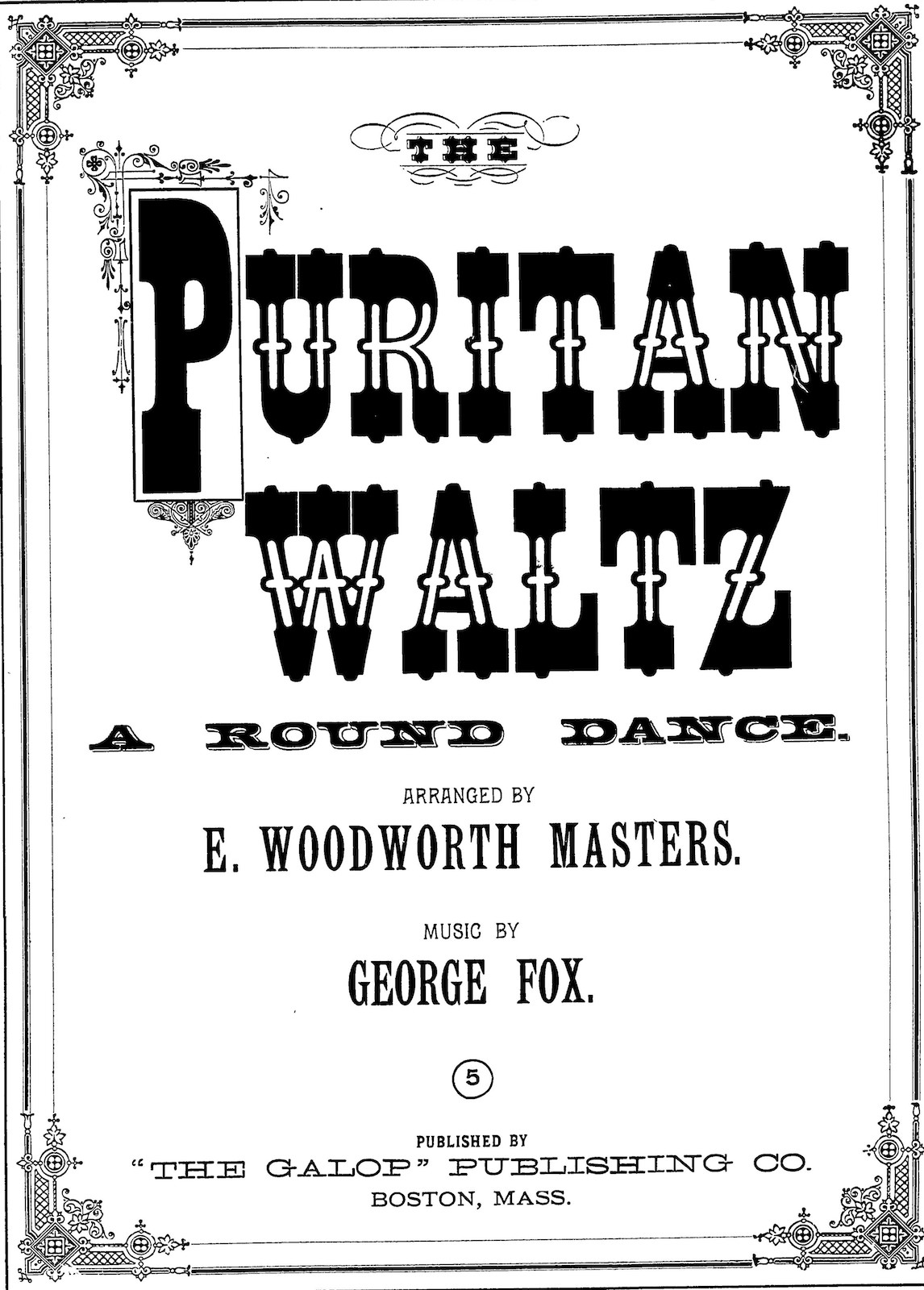
 The Puritan Waltz is not, actually, a waltz. It’s a galop variation found in both Round Dancing (M. B. Gilbert, Portland, Maine, 1890) and La Danse (G. W. Lopp, Paris, 1903). Gilbert described it under the name The Puritan Waltz and also referenced it under The Jubilee. Lopp chose truth in advertising over adherence to the original and went with La Puritan Galop. The two descriptions match perfectly in the practical aspects, though Gilbert gets a little more poetic in naming the parts of the dance after…a whaling expedition? I feel like there must be some story behind a dance with parts called “The Calm”, “The Fluke”, and “The Gale”, but I’ve no idea what it might be. Nantucket Puritans?
Category: Victorian
-
The Puritan Waltz (La Puritan Galop)
-
Late Victorian Waltz Variations: The College Step
Working my way through the waltz variations in Round Dancing (M. B. Gilbert, Portland, Maine, 1890) and La Danse (G. W. Lopp, Paris, 1903), here’s one that can fairly confidently be classified as a step rather than a sequence written for a particular piece of music. It’s actually quite interesting, though less for the step than for the fact that though at first glance it looks like a two-part sequence, it’s actually not. Gilbert specifically (and ungrammatically) wrote:
Repeat ad lib, commencing at the second part. At the termination of the side movement. Waltz at pleasure, introducing the second part at will.
In other words, waltz (the first part) for as long as you like, then do the second part (a set of sideways movements akin to a racket) for as long as you like. In short, use the second part as a variation in your waltzing. That’s in line with how I suspect many of these variations were actually used, but it’s unusual to see it stated so explicitly.
-
Late Victorian Waltz Variations: The Eugénie
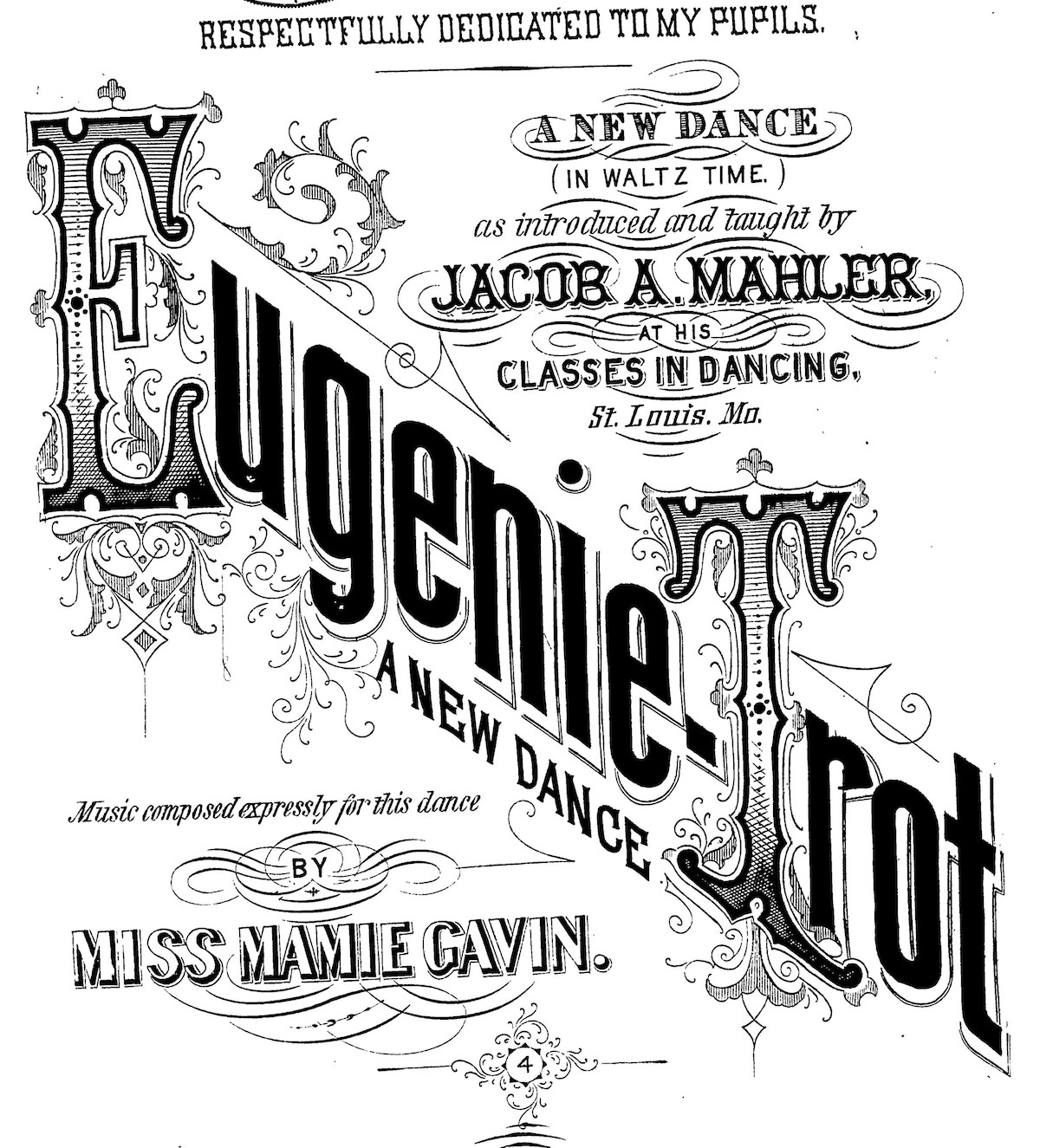 The Eugénie, or Eugenie-Trot, is yet another of the many variations published in M. B. Gilbert’s book of couple dances, Round Dancing (Portland, Maine, 1890) and later, in translation to French, in G. W. Lopp’s La Danse (Paris, 1903). It was attributed by both authors to St. Louis dancing master Jacob Mahler, as is confirmed by the cover of the sheet music shown at left (click to enlarge). I would not regard it as a particularly important or significant variation; it warrants a reconstruction only as part of my overall progress through every dance in those two books.
The Eugénie begins in the “military” position (described at length, with a photo, here) with the dancers opened up side by side, the gentleman’s right arm around the lady’s waist and her left hand resting on his shoulder or upper arm, depending on their relative heights. The gentleman starts with the left foot and the lady with the right. The gentleman’s steps are given; the lady dances opposite.
-
CD Review: The Grand Victorian Ballroom
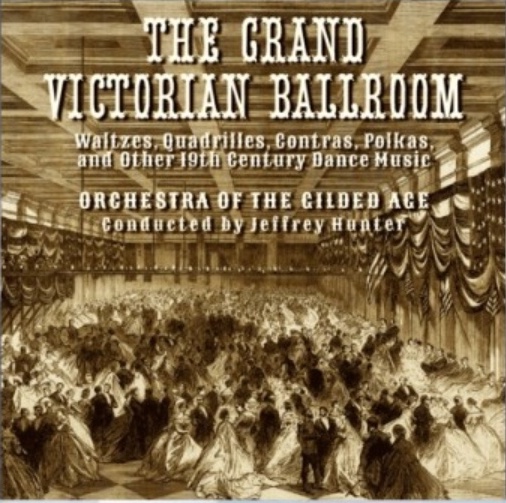 The Grand Victorian Ballroom: Waltzes, Quadrilles, Contras, Polkas, and Other 19th Century Dance Music (Gaslantern Records, 2012), with its accompanying sheet music, is the second of two CDs I received for my birthday earlier this year, along with North & South. But unlike North & South, this album was designed for dancing, so it is both beautifully played for listening pleasure and entirely functional as dance music. The musicians, once again, are the members of the Orchestra of the Gilded Age (I still don’t know exactly who those members are) conducted by Jeffrey Hunter.
Edited 1/26/2026 to add: Sadly, this company seems to be out of business and the CD and sheet music book are no longer available for sale, though they might still be found used somewhere. All links have been changed to archive links.
-
Scotch, Hungarian, whatever (cotillion figure)
H. Layton Walker’s Grand Scotch Chain, published in Twentieth Century Cotillion Figures, by (Two Step Publishing Company, Buffalo, New York, 1912), is only moderately interesting as a figure, but tracing its progress from a figure that was neither “grand” nor “Scotch” when it started out is an interesting illustration of how cotillion figures were transmitted across time and international borders in the nineteenth and early twentieth centuries.
The figure itself is quite simple:
- Two couples separate and select new partners
- They form a four-couple quadrille set
- Head gentlemen turn by right elbows once and a half round, then give left elbows to opposite ladies and turn to place with her
- Side gentlemen repeat
- Head ladies repeat
- Side ladies repeat
- All take partners and waltz
-
Double Grand Chain (a march or cotillion figure)
I first came across Double Grand Chain when flipping through Twentieth Century Cotillion Figures, by H. Layton Walker (Two Step Publishing Company, Buffalo, New York, 1912) for interesting cotillion (dance party game) figures. Like Winthrope, Double Grand Chain is not terribly game-like beyond the basic cotillion setup of dancing with one person and then finding a new partner, but it would make an interesting addition to a grand march for a group of reasonably skilled dancers.
Double Grand Chain was not original to Walker; it also appeared in all the editions of Allen Dodworth’s Dancing and its relations to education and social life running from 1885 to 1913 (the link is to the 1900 edition), which puts it firmly in the “late Victorian” category. Since it did reappear in 1912 separately from the Dodworth reprints, I’d still consider it legitimate for a ragtime-era event, and it is sufficiently innocuous in style that I wouldn’t be bothered by its use at a mid-nineteenth-century event either.
-
Aladdin Quadrille
Like the New Scotia Quadrille, the Aladdin Quadrille is one of several single-figure quadrilles found in the “New, Enlarged, & Complete Edition” of D. (David) Anderson’s Ball-Room Guide (Dundee, this edition undated but probably c1886). This is a simple, fun figure that would fit easily into a Scottish-themed ball.
Despite there being various quadrille sets called the Aladdin Quadrilles, Anderson doesn’t seem to have had any specific music in mind. He notes only that it can be danced in 2/4 or 6/8.
Aladdin Quadrille (8 bars introduction + 64 bars x4)
8b Introduction/honors (not repeated)
8b All promenade round
4b Ladies advance to the center and retire
4b Gentlemen advance to the center and retire
8b All set to partners and turn by the right hand
8b Head couples advance and retire, then half right and left
8b Side couples advance and retire, then half right and left
8b Grand chain half round to places
16b All waltz (in duple time) around (see performance notes below)The figure is danced four times, with the head couples leading on the first and third iterations and the side couples leading on the second and fourth.
-
A Fancy Dress Ball, Saratoga, 1847
Another costume-heavy description of a fancy dress ball was published in The New York Herald on August 17, 1847, in the social column “The Watering Places” on page two. The ball was held at Congress Hall of the United States Hotel in the summer resort town of Saratoga Springs, New York, on August 14, 1847.
Sadly, no information is given about the dancing, though the writer does mention the generous size of the hall, one hundred and fifty by fifty feet, and the beautiful decorations, featuring flowers and greenery plus “miniature flags of every nation which supports a navy” hanging “just above the heads” of the dancers.
-
Imperial Gavotte
The Imperial Gavotte is one of the many schottische variations included in M. B. Gilbert’s book of couple dances, Round Dancing (Portland, Maine, 1890) and in G. W. Lopp’s La Danse (Paris, 1903). It is attributed to Professor A. T. Graves of Albany, New York, and noted by Gilbert to have been accepted by the American Society of Professors of Dancing in New York on September 4, 1889. The Society endorsement gave it enough exposure for it to turn up outside Graves’ own studio: in the October 26, 1890, issue of the St. Louis Post-Dispatch (St. Louis, Missouri), it is listed as one of the new dances to be taught by John Mahler.
-
American Gavotte / Polka Américaine
The American Gavotte is another of the variations published by dancing master M. B. Gilbert in his manual of couple dances, Round Dancing (Portland, Maine, 1890) and republished by G. W. Lopp in La Danse (Paris, 1903). It was attributed by Gilbert to James P. Brooks of Pittsburgh, Pennsylvania (and by Lopp to “J.-D. Brooks”). Gilbert also noted that it was adopted by the American Society of Professors of Dancing, New York — this would have been in 1886, from contemporary writeups of the event — and published by permission of White Smith Music Publishing Co. Lopp listed it as “Polka Américaine (American Gavotte)”
I’ve discussed a couple of other American “gavotte” variations before, but both of those were for the schottische. The American Gavotte is listed as a polka, though it actually works perfectly well to schottische music and there is some confusion surround how it is notated that suggests that it might have originally been meant as a schottische; see the music note below. It certainly has some choreographic kinship with the schottische gavottes in that it also uses the rhythm pattern “1&2&3,4” stepped as “slide, chassé, chassé, close” or “slide-close-slide-close-slide, close”. This is one measure of schottische as usually counted, but two measures of polka. Because of the pattern of the following four beats of music, I actually prefer to break the first four up into two bars, polka style, as follows, with dancers starting on their first foot (his left, her right):
-
The Western Normal Newport
The Western Normal Newport was named after the Western Association Normal School Masters of Dancing, a professional organization for dancing masters in western North America. “Normal school” sounds odd to modern ears, but historically, it didn’t mean what we’d imagine today. A normal school was a teacher-training school, where the “norms” of teaching and subject material were taught; more information on normal schools in general may be found here. The Western Association Normal School was founded in 1894 under Canadian dancing master John Freeman Davis, its first president.
My only source for the Western Normal Newport is George Washington Lopp’s La Danse (Paris, 1903). Lopp was from the northwestern USA and may have been a member of the Normal School or at least aware of it. The variation’s name, as given in French by Lopp, was Le Western Normal Newport, attributed to l’Association de l’École normale des Maîtres de danse de l’Ouest.
Given that the school was founded in 1894, the Western Normal Newport was obviously created too late to appear in M. B. Gilbert’s Round Dancing, published in Portland, Maine, in 1890, from which Lopp cribbed so much of his own book.
-
Ripple, Ripple, Jersey
The Ripple Galop and the Jersey are two galop variations found in both M. B. Gilbert’s Round Dancing (Portland, Maine, 1890) and George Washington Lopp’s La Danse (Paris, 1903), a French translation of Gilbert with some additions and changes. Both variations use the late nineteenth-century American waltz-galop technique of a leap along the line of dance followed by a side step and a cut (or close of the feet) in the rhythm “1&2” rather than the slide-chassé of the galop, extending it into the “Newport” pattern of a leap along the line of dance followed by a series of side-closes, stretching the basic step-unit from one to two measures. The key difference is where the side steps and closes fall relative to the strong beats of the music:
galop: 1 (side) & (close) 2 (side)
waltz-galop: 1 (back/forward) & (side) 2 (cut/close)The galop pattern ends in an open position. The waltz-galop normally does as well, but it can also be ended elegantly at the end of the music by a close of the feet rather than a cut. This alteration of the relationship of movements to music in dances of the “new waltz” family is what makes these variations interesting to me.
-
Mr. Layland’s Polka Contre Danse
There are at least five different dances in the second half of the nineteenth century whose name is some variation on the generic “polka country dance”. The one I’m looking at here was published as both “Polka Contre Danse” and just “Polka Contre”. Unusually, it is attributed to a particular dancing master, Mr. Layland, who was active in London in the mid-19th century. I’ve mentioned him before in the context of his mescolanzes. That makes it very much an English dance, despite its appearance in a couple of American dance manuals.
My first English source for the Polka Contre Danse, The Victoria Danse du Monde and Quadrille Preceptor, dates to the early 1870s, but I suspect that it actually dates back to the 1850s. It actually appears earlier in two of the manuals of Boston musician/dance caller/publisher Elias Howe, the earlier of which is from 1862. Howe was a collector and tended to throw dances from every book he collected into his own works, so I suspect there is an earlier English source somewhere, possibly by Layland himself. Maybe someday I’ll find it.
Until then, on with Polka Contre Danse!
-
Susan’s Sociables
When I first wrote about the quadrille figure called the Sociable almost seven years ago, I noted that some sources offered slightly different sets of figures, and at least two suggested that the choice of figures was up to the caller:
“No positive rule as to what figure shall be called in the Quadrille Sociable. The choice is left entirely to the prompter.” (Brookes, L. De G. Brookes on Modern Dancing. New York, 1867)
“Prompters often call figures in the ‘Sociable’ to suit their fancy, introducing the ‘Star Figure,’ ‘Grand Chain,’ etc.” (De Garmo, William. The Dance of Society. New York, 1875)
I rarely exercise the option to call variant figures; my habit has been to do the most common four-figure sequence twice over, once for the ladies to progress and once for the gentlemen, with an eight-bar “All chassez” and honors coda at the end. Including introductory honors, this calls for a structure of 8b + 32bx8 + 8b. Working with live musicians, I can have music played to fit this pattern exactly. Or, if I am using the Sociable as the final figure of a quadrille, the short version with the progressive figures done only once (ladies progressing) is plenty, and since 8b + 32bx4 + 8b is a common finale structure, if necessary, it is easy to find a recording with that pattern.
-
Waltzing Around
A recent mailing list discussion centered on how to quickly teach people to do a "waltz-around", the style of country dance progression in which two couples waltz around each other once and a half times. This is most famously part of the mid- to late-nineteenth-century Spanish Dance, as well as other American waltz contra dances (such as the German Waltz and Bohemian Waltz). It dates back at least as far as the late 1810s to early 1820s in England, when Spanish dances were an entire genre of country dances in waltz time, and both they and ordinary waltz country dances featured this figure, sometimes under the names "poussette" or "waltze". I expect it goes even further back on the European continent, but I haven't yet pursued that line of research.
As a dancer, the waltz-around has always been one of those figures that I just…do. I'd observed that it's difficult for beginners to master the tight curvature of the circle and making one and a half circles in only eight measures, but as an experienced waltzer, I've long been able to do it instinctively. And I'd never broken down precisely what I did or worked out how to explain it to others.
So I suppose it's about time!
-
Ladies leading, 1898
Almost exactly a year ago, I wrote about some of the tidbits of evidence of ladies or gentlemen dancing in same-gender couples in Regency-era ballrooms. I’m returning to the topic of same-gender dancing with an interesting article I discovered in an issue of a late-nineteenth-century American dance magazine, The Two Step, published at the time by dancing master and author H. N. Grant, out of Buffalo, New York.
The June, 1898, issue (Vol. 5, No. 47) includes a short essay on an important topic: “May a Lady Dance Backward.” It opens with a strong statement in favor:
Should a lady be taught to use the backward step in the waltz?
Yes we say, most emphatically yes.
That opens up all sorts of interesting questions, doesn’t it? Were ladies not generally even taught to waltz backward? Was that actually controversial?
(more…) -
Prince Leopold’s Birthday Ball, 1859
One of the most charming descriptions of a fancy dress ball in my collection is that of the event held at Buckingham Palace in honor of the sixth birthday of Queen Victoria's youngest son, Prince Leopold, on April 7, 1859. This was a juvenile, or children's, ball, but, as we know from descriptions of the dancing lessons given to Victoria's children, the level of dancing skill even at young ages was considerably higher than one would expect from children today. That said, it's not clear to me whether the youngest children really danced all the dances or whether that was left to the older ones, or perhaps the parents.
The description I have was printed in The Albion, A Journal of News, Politics and Literature, on April 30, 1859. The Albion was a weekly New York newspaper that covered British matters extensively and was read by expatriates. The description was probably copied directly from a London newspaper.
-
Newport Fancy Dress Ball, 1850
The final fancy dress of the Newport summer season of 1850 occurred on Wednesday, September 4th. It was covered by The Boston Herald on September 5th (“Grand Fancy Ball at Newport”, p. 4) and more extensively by The New York Herald on September 6th (“The Grand Fancy Dress Ball at Newport”, p. 1). The bulk of the coverage was devoted to lists of attendees and their costumes, as is typical for fancy dress balls, but there are some other tidbits of useful information as well. The New York Herald article is extremely lengthy, so I have not transcribed all of it. The article from The Boston Herald is quite short, but not nearly as interesting.
The ball was held at the rebuilt Ocean House, the original of which had opened in 1844, burned down, and been rebuilt. This Ocean House was not the same as the modern Ocean House in Newport. A different hotel by the same name opened in 1868, was demolished in 2005, and then rebuilt again in 2010.
At the RhodeTour website, Dr. Brian Knoth writes about the first two Ocean Houses, with specific mention of the 1850 Fancy Dress Ball:
-
Tracking the Mescolanzes
The topic of mescolanzes, four-facing-four country dances, and whether the famous dance La Tempête was the only surviving member of the genre by the mid- to late nineteenth century, came up in an email exchange recently. Mescolanzes are one of those dance genres for which I have spent years slowly accumulating examples, so I thought I’d talk a little bit about the format and where dances called mescolanzes appeared over the course of the nineteenth century.
I’m going to limit this quick survey to more-or-less anglophone countries — England, America, Scotland, Canada, and Australia — since I’ve not yet collated all the information I have from other countries. I’m also not going to discuss La Tempête specifically, since that is an enormous topic all on its own. Here and now, I will only survey dances appearing under the name or classification “mescolanze” and its several (mis)spellings.
-
Revisiting the Flirtation Figure
Almost six and a half years ago, I reconstructed and briefly discussed the Flirtation Figure, which appeared in William Lamb’s How and What to Dance (London, 1903 or 1904) as a separate figure after the usual five figures of the first set of quadrilles. My slightly revised reconstruction of Lamb’s figure:
Flirtation Figure (8 bars + 32 bars x4 + 8 bars)
8b Introduction (not repeated)
4b Grand Circle: all take hands and forward and back
4b All turn partners two hands
4b All four ladies forward and back
4b All four gentlemen forward, turn, and bow to lady at their left (their corner lady)
4b Facing corners, all balance by stepping right, close left behind, step right, touch toe of left in front (1, 2, 3, 4); repeat to left
4b Turn corners two hands, ending in gentleman’s original place and taking closed hold
8b All galopade around the set (four-slide galop to each position, alternating over hands/over elbows)
Repeat previous thirty-two bars three more times. After last repetition:
8b Grand Circle and turn partners two hands -
Starting the Waltz, Cellarius Style
Several years ago I wrote about starting the “new waltz” of the late nineteenth century in the way recommended by Allen Dodworth, who suggested a preparatory measure of music in which the dancers move from the usual starting orientation for couple dances, gentleman facing the wall/lady facing the center of the room, to one in which the gentleman’s back is to line of dance, making it easier for him to accomplish a clean leap backward on the first step of the waltz, while the lady faces forward and can easily perform her forward leap. I’d thought at the time to make that post part of a series addressing different ways recommended for starting various forms of waltz over the course of the nineteenth century, but for one reason or another never got back to the topic.
Here’s another short installment in what is now a very drawn-out series.
-
A Ballroom Repentance, 1882
Annie Edwardes’ two-volume novel, A Ballroom Repentance (London: Richard Bentley & Sons. 1882), was apparently a somewhat racy novel by Victorian standards. By today’s, it falls into that dreary research category of deservedly-obscure novels that I plow through for the dance scenes.
Edwardes (c1830-1896) was an English author successful enough to publish twenty-one novels between 1858 and 1899, the last published posthumously. Three were adapted for theatre. I haven’t read any of her other books, but the title of this one attracted me, since it promised a ballroom scene which might have include some useful tidbits of dance information. The ballroom scene comes very near the end, but to be thorough, I read all seven hundred or so pages of what it would be fair to call Victorian soap opera. It’s a quick read with fewer words per page than a modern novel, so that wasn’t quite as tedious as it sounds, but I can see why Edwardes has not come down to us as a major writer.
-
On evening parties with dancing, 1860
The most fashionable as well as pleasant way in the present day to entertain guests is to invite them to evening parties, which vary in size from the “company,” “sociable,” “soiree,” to the party, par excellence, which is but one step from the ball.
The entertainment upon such occasions may vary with the taste of the hostess or the caprice of her guests. Some prefer dancing, some music, some conversations. Small parties, called together for dramatical or poetical readings, are now fashionable, and very delightful.
— The Ladies’ Book of Etiquette and Manual of PolitenessI first came across Florence Hartley’s The Ladies’ Book of Etiquette and Manual of Politeness (G. G. Evans: Philadelphia, 1860) via the July, 1861, issue of Godey’s Lady’s Book, which excerpted the section on the etiquette for a lady hosting an evening party. There is a matching section for the (female) guests at an evening party as well as sections for ladies hosting or attending balls. I have spent a great deal of time over the years reading about mid-nineteenth century ballroom etiquette, but considerably less on that for more informal events. I thus found Mrs. Hartley’s thoughts on the subject quite interesting. It would be fun to host smaller events such as these, if one had both the sizable rooms and the servants that Mrs. Hartley assumes will be available or hired for the night.
-
Mysteries of the Manitou
I keep saying that I don’t think there’s much need to memorize all the variations in sources like Melvin Ballou Gilbert’s Round Dancing (Portland, Maine, 1890) in order to accurately reenact the social dance of late nineteenth-century America. But I keep reconstructing and posting them anyway, since I find there’s often something to learn by examining how they’re constructed. The dance published as the “Maniton”, which I am fairly sure is a typo for “Manitou”, has two elements that caught my interest: a major change between sources and an unusual use of the “new waltz”, the late nineteenth-century version of the box step that I’ve been thinking and writing about recently.
First, the name. In Gilbert, both the index and the title within the text are “Maniton”. As far as I can tell, that just isn’t a word. In the other source for the dance, George Washington Lopp’s La Danse (Paris, 1903), much of which is merely a French translation of Gilbert, it is “Maniton” in the text but “Manitou” in the index. I think the latter is the actual name of the dance and/or its intended music. Switching “n” for “u” is a typesetting error I’ve encountered elsewhere.
-
The Trio
Since I frequently have to deal with an imbalance in numbers between the ladies and the gentlemen at nineteenth century balls, I’m always interested in dances that use a trio formation. This can be one gentleman with two ladies or vice-versa, though the former is the more common situation.
This dance, simply called “The Trio”, appears in at least two editions of Elias Howe’s American dancing master, and ball-room prompter (Boston, 1862 and 1866). Howe’s instructions are a bit vague and neglect to mention the actual timing of the figures, but a little experimentation convinced me that the following reconstruction is workable and fun. This is an extremely easy dance, good for groups of beginners.