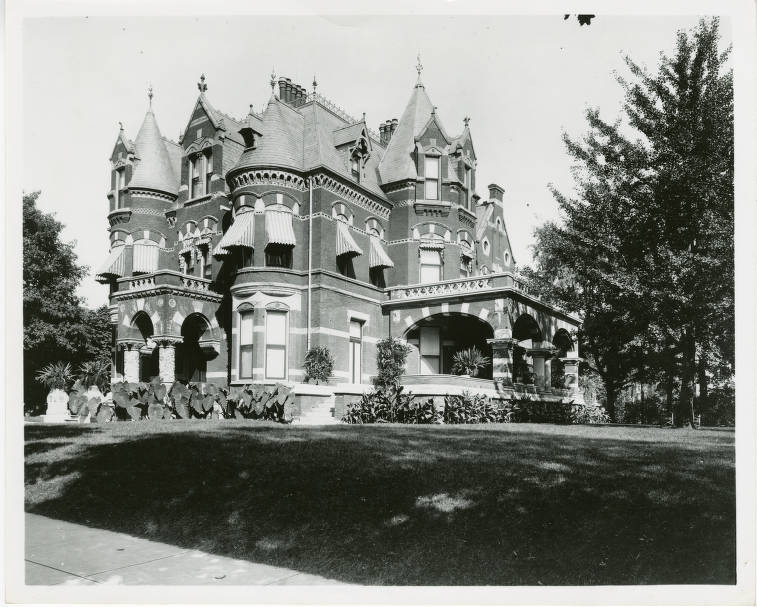
On Monday, December 27, 1909, an elaborate cotillon, meaning an evening of dance party games, was given by the McGowan family in the yellow and gold third floor ballroom of their turreted Romanesque “chateau” on Delaware Street in Indianapolis, pictured above in an image courtesy of the Indiana Historical Society.
The house and the McGowan family are extremely well-documented. Hugh McGown (1857-1911) was a first-generation American, the son of Irish immigrants, and a self-made man who made a fortune in electric street rail as President of the Indianapolis Traction and Terminal Co. A brief biography may be found here. He and his wife Kate had four daughters: Marjorie, Louise, Frances, and Isabel, who would have been roughly 21, 20, 16, and 14 in 1909.
The house was constructed in 1874 for the grand sum of $80,000 (about $2.3 million in today’s money) and bought by the McGowans in 1903. It notably featured a six-foot-wide grand staircase running from the cellars to the ballroom on the top floor, which was large enough for fifty dancing couples plus an orchestra. Sadly, the house was eventually sold, ended up in the hands of the Knights of Columbus, and was demolished in 1963. A detailed history, with floor plans and interior and exterior photos, including a color shot of the outside, may be found here.
Now, about the cotillon itself:
It was hosted by the McGowan parents for their daughters. The senior McGowans were assisted by Mrs. John T. Brush and some other friends. The two oldest McGowan daughters, Marjorie and Louise, with male partners, served as leaders of the cotillon figures. The other daughters were not mentioned and may have been too young to attend.
The guest list included people from a wide geographic range: Cincinnati, New York, Louisville, Grand Rapids (Michigan), Princeton, Chicago, Kansas City, etc. I had never realized Indianapolis was the sort of social hub where so many wealthy young people would congregate over the holidays! It’s not clear whether this was a small event or whether they actually had fifty couples to fill the ballroom and the writer of the coverage just didn’t bother to list all of the attendees.
The decor was seasonal, though the writer did not go into detail: “The room was charming with its Christmas decorations, the only flowers being poinsettias.”
The evening began with a grand march and included ten figures, six of which employed favors. There was a supper after the dance. The favors, described in more detail below, were brought by the McGowan’s from Europe. Mrs. John T. Brush dressed as a Fairy Godmother and helped distribute favors.
Some specifics:
For the grand march, “the girls all appeared in exquisite poke bonnets of different shades of lavender, trimmed with pompons [sic] of pink. blue, and white, made with high crowns, tied with ribbons to harmonize with the bonnets.”
The figures included:
- a butterfly figure in which the ladies “wore butterflies made of bolting cloth, hand painted in delicate shades of blue, pink, and lavender. When the time came for the dance the girls danced into the ballroom, carrying spangled butterfly favors for the men which were made of the same material and tied with spangled streamers and green fringe. To each favor was attached a brilliant pin.”
- an unknown figure that included “flower whistles for the girls and animal brushes for the men”.
- a “Roosevelt figure”, apparently named for former U.S. President Theodore (Teddy) Roosevelt, a noted outdoorsman and hunter who had just left office that year, in which “the men wore false faces to represent animals and the girls danced in to shoot at them with toy pistols“, probably as a method of selecting a partner, which was the usual function of this sort of cotillon.
- a wand figure, featuring “bright colored wands decorated beautifully for the girls and fancy canes with grotesque faces for the men”.
- an unknown figure with particularly admired favors for the ladies: work bags “made of pink and blue silk, to which were fastened gold baskets trimmed with tiny pink rose buds.”
- a basket figure with favors of “round baskets of yellow, blue, and pink, trimmed with tissue roses of the same shade and tied with ribbons, and for the men lavender, blue and gold tinsel butterflys [sic].”
- more than one grotesque figure, for one of which the men received “green caps with the words, “Music in My Head.” “
- the finale, featuring an elaborate miniature aeroplane: “The lights were turned low and the airship was lighted with thirty-six electric lights of different colors. Concealed in this ship was the confetti in all colors of the rainbow, which was showered on the dancers as the young women sang “Up in the Aeroplane.”
That accounts for seven or eight figures, depending on whether one counts the aeroplane finale as a figure. The other two or three would have included other “grotesque” ones. It’s a shame there are no details of how any of them actually worked except the minimal information given in the description of the Roosevelt figure, but in general, each figure would have involved some sort of mixing or partner-selecting element, either as a group or couple by couple. Once one had been matched with a partner, the favor was bestowed and the two danced together.
My most immediate reaction to all this, as is often the case, was to be impressed by the level of conspicuous consumption involved in a party of this social class: favors brought from Europe and a miniature aeroplane with electric lights! The main focus of the column was not, unfortunately, to describe the dancing, but to make sure all the readers know how elaborate the favors were and who the important guests were!
The more practical dance historian side of me took note of the quantity of figures, in case I want to throw a party like this myself, on a much tighter budget. Ten figures in an evening, even excluding the finale, doesn’t seem like an enormous number. But depending on the number of couples, it could take twenty minutes or more to run some figures. Six with favors: butterflies, wands, work bags, baskets, flower whistles/animal brushes, and one other not described. The animal masks and toy pistols of the Roosevelt figure were probably props, not favors. The poke bonnets, green caps, and whatever else was used for the “grotesque” figures likewise. They might have been favors in the modern sense, meaning items the guests took home from the party, but not in the dance sense of a favor gifted to one’s partner as part of a cotillon figure. And having an extra person not involved in the dancing to distribute the favors seems like a good idea – if only I had the staff to have an entirely separate group of people managing the event while I organized the dancing!
A postscript:
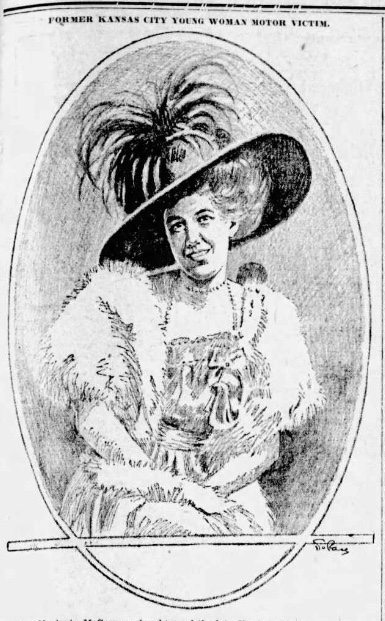 The fate of the McGowan daughters who led the cotillon and their younger sisters is known and, unfortunately, not very happy. In 1916 Marjorie, engaged to be married, was killed in a car accident in Connecticut while returning to New York after a Yale-Brown football game, as reported byThe Kansas City Times on Monday, November 13, 1916. The picture at left is from that article; click to enlarge. Louise married a famous millionaire race car driver in 1914, but he was killed only a couple of months later, and she seems to have remained a widow until her death in 1978. The third daughter, Frances, also married in 1914, was widowed at age 39, and seems not to have remarried before her death in 1972. The fourth daughter, Isabel, seems never to have married, but at least lived into her early 90s.
~~~~~~~~~~~~~~~~~~~~~~~~
A complete transcription of the original coverage fromThe Indianapolis Star, Tuesday, December 28, 1909, p. 7:
SOCIAL SIDE OF CITY
~~~~~
PARTY AT McGOWAN HOME
~~~~~
YOUNG PEOPLE PARTICIPATE IN HOLI-
DAY COTILLON, FOR WHICH NOV-
EL IMPORTED FAVORS
WERE USED
One of the most beautiful parties of the holiday season was the cotillon given last evening by Mr. and Mrs. Hugh J. McGown at their home on North Delaware Street, when they entertained for their daughters, the Misses McGowan. The guests were received in the yellow and gold ballroom on the third floor. The room was charming with its Christmas decorations, the only flowers being poinsettias. The favors were quite novel, and were brought from Europe by Mr. and Mrs. McGowan. There were ten figures, six being danced with pretty favors.
The dance opened with the grand march, when the girls all appeared in exquisite poke bonnets of different shades of lavender, trimmed with pompons [sic] of pink. blue, and white, made with high crowns, tied with ribbons to harmonize with the bonnets. One of the beautiful figures was the butterfly figure. The girls wore butterflies made of bolting cloth, hand painted in delicate shades of blue, pink, and lavender. When the time came for the dance the girls danced into the ballroom, carrying spangled butterfly favors for the men which were made of the same material and tied with spangled streamers and green fringe. To each favor was attached a brilliannt pin. This was one of the most effective figures, and was a pretty sight. Mrs. John T. Brush was dressed as the fairy godmother, and distributed some of the favors for the dances. For another of the figures there were flower whistles for the girls and animal brushes for the mn. A figure that caused much merriment was the Roosevelt figure, when the men wore false faces to represent animals and the girls danced in to shoot at them with toy pistols. For the wand figure there were bright colored wands decorated beautifully for the girls and fancy canes with grotesque faces for the men. Some of the prettiest favors were work bags for the girls. They were made of pink and blue silk, to which were fastened gold baskets trimmed with tiny pink rose buds. Still another pretty figure was the basket. There were round baskets of yellow, blue, and pink, trimmed with tissue roses of the same shade and tied with ribbons, and for the men lavender, blue and gold tinsel butterflys [sic]. For one of the grotesque figures for the men there were green caps with the words, “Music in My Head.” or the finale there was a miniature aeroplane. The lights were turned low and the airship was lighted with thirty-six electric lights of different colors. Concealed in this ship was the confetti in all colors of the rainbow, which was showered on the dancers as the young women sang “Up in the Aeroplane.” The cotillon was led by Miss Marjory McGowan and Dr. Freeman Hibben, assisted by Miss Louise McGowan and Standish Meacham of Cincinnati, O. For the last dance the girls all wore the favors.
Mr. and Mrs. McGowan were assisted by Mrs. John T. Brush and a group of their friends. After the dance a supper was served. Among the guests were Miss Edith Meacham of Cincinnati, the house guest of the Misses McGowan, and Lesley Gordon of Chicago, Ewing Walker of Kansas City, Ned White of New York, the Misses Rankin of Louisville, Ky; Cora Becker of New York, Mary Lodge McKee of New York, Eleanor Young of New York, Miss Long of Grand Rapids, Mich. Last evening Harvey S. Talbott, who is home from Princeton, gave an informal dinner for the Misses McGowan and a number of the debutantes and a group of the young men who are home from college.


Leave a Reply