
Category: Reconstruction

  • Paine’s Quadrilles, Twelfth Set, 1819 (4 of 4)

    (This is fourth in a series of four posts covering Paine’s Twelfth Set.  The introductory post in the series may be found here, figures one and two here, and figures three and four here.)

    Concluding my series on Paine’s Twelfth Set, the final figure!

    No. 5, tune “La Nouvelle Fantasia
    Figure.
    Chassez croisez huit, les quatre Cavaliers en avant 4 mes, les quatre dames de meme, balancez tour de mains, la Cavalier seul en avant et en arriere 8 mes, la dame seul de meme.
    La Grand Promenade.

    All 8 chassez across and back again, the 4 Gent: advance and retire 4 bars, the 4 Ladies the same, balancez and turn your partners, one Gent: advance and retire twice 8 bars, the opposite Lady do the same.  
    Promenade all 8.
    (more…)

  • Paine’s Quadrilles, Twelfth Set, 1819 (3 of 4)

    (This is third in a series of four posts covering Paine’s Twelfth Set.  The introductory post in the series may be found here and figures one and two here.)

    Continuing on with Paine’s Twelfth Set, the next two figures…

    No. 3, tune “L’Aimable
    Figure de La Poule. — or
    Le 4 dames font le moulinet pendant que les 4 Cavaliers font la grand Promenade a droite, ils donnent les mins a leurs dames et balancez tour de mains pour se remettre a sa place, les tiroirs a quatre et restez à la place opposee, de meme les 4 autres demie Promenade tous les 8, Jusqua [sic] votre place et tour de mains en place.
    Contre Partie.

    The 4 Ladies moulinet while the 4 Gent: do grand Promenade to the right, the 4 Gents: give their hands to their partners, balancez and turn them round to their places, the tiroirs 4 and stop at the opposite place the other 4 the same, half Promenade all 8 to your places, and turn your partner round to your place.  
    The same again.

    (more…)

  • Paine’s Quadrilles, Twelfth Set, 1819 (2 of 4)

    (This is second in a series of four posts covering Paine’s Twelfth Set.  The introductory post in the series may be found here.)

    All right, let’s move on to the actual figures!  In my transcriptions below of the French and English instructions, the capitalization, spelling, punctuation, and lack of accents over the French vowels are all as printed in the original.

    No. 1, tune “La Belle Flamand”
    Figure de la Pantalon — or
    Quatre demie chaine Anglaise, les 4 autres demie chaine Anglaise, demie Promenade tous les 8, et tour de mains a votre place, chaine des dames celles qui ont commencez [sic], balancez 8 et tour de mains. 
    Contre Partie.

    Four half right and left, the other four the same, half Promanade [sic] all 8 to your place and turn your partners round, Ladies chain by those who began the dance, balance 8 and turn your partners round. 
    The same again the other 4.

    (more…)

  • Paine’s Quadrilles, Twelfth Set, 1819 (1 of 4)

    As with my earlier reconstructions of Howe’s figures for “Les Rats” and the third set of Simonet’s Parisian Quadrilles, I was primarily motivated to reconstruct Paine’s Twelfth Set of Quadrilles by the existence of a high-quality recording of the music.  I’m not sure what prompted Green Ginger to choose this quadrille, out of more than a dozen of Paine’s other sets of quadrille music (besides his most-famous and oft-recorded first) to include on their CD of Regency-era dance music, Music for Quadrilles, but it’s an excellent set of tunes played beautifully.

    I’ve used these recordings in the past as variant music for the standard quadrille figures, which they were structured to fit.  But Paine’s original sheet music also included new figures for those who didn’t want to dance the usual ones, and they turned out to have some unusual figures which I quite like.

    (more…)
  • The Dip Schottische

    The Dip Schottische is one of the minor schottische sequences created by dancing masters in the early 1910s.  In this case, the author was one I. C. Sampson, of Lynn, Massachusetts, and the dance was published in both the first and second editions of F. Leslie Clendenen’s compilation Dance Mad (St. Louis, 1914).  Unfortunately, the dance instructions have one major ambiguity that makes it very difficult to come to a definitive reconstruction: what, exactly, does “turn” mean?  Here’s the original language for one move in the dance:

    “One Step” turn (pivot, four steps, two measures)

    The problem is that there is no single “one step turn”.  There are at least two very plausible candidates: the spin and the traveling turn, better known today as pivots.  If I had to guess which would be the “one step turn”, I’d guess the spin, but there are some problems with that in regard to this particular sequence.  But there are problems with the traveling turn as well.  Here’s some of what I considered when trying to choose between them:

    (more…)

  • We have a problem here…

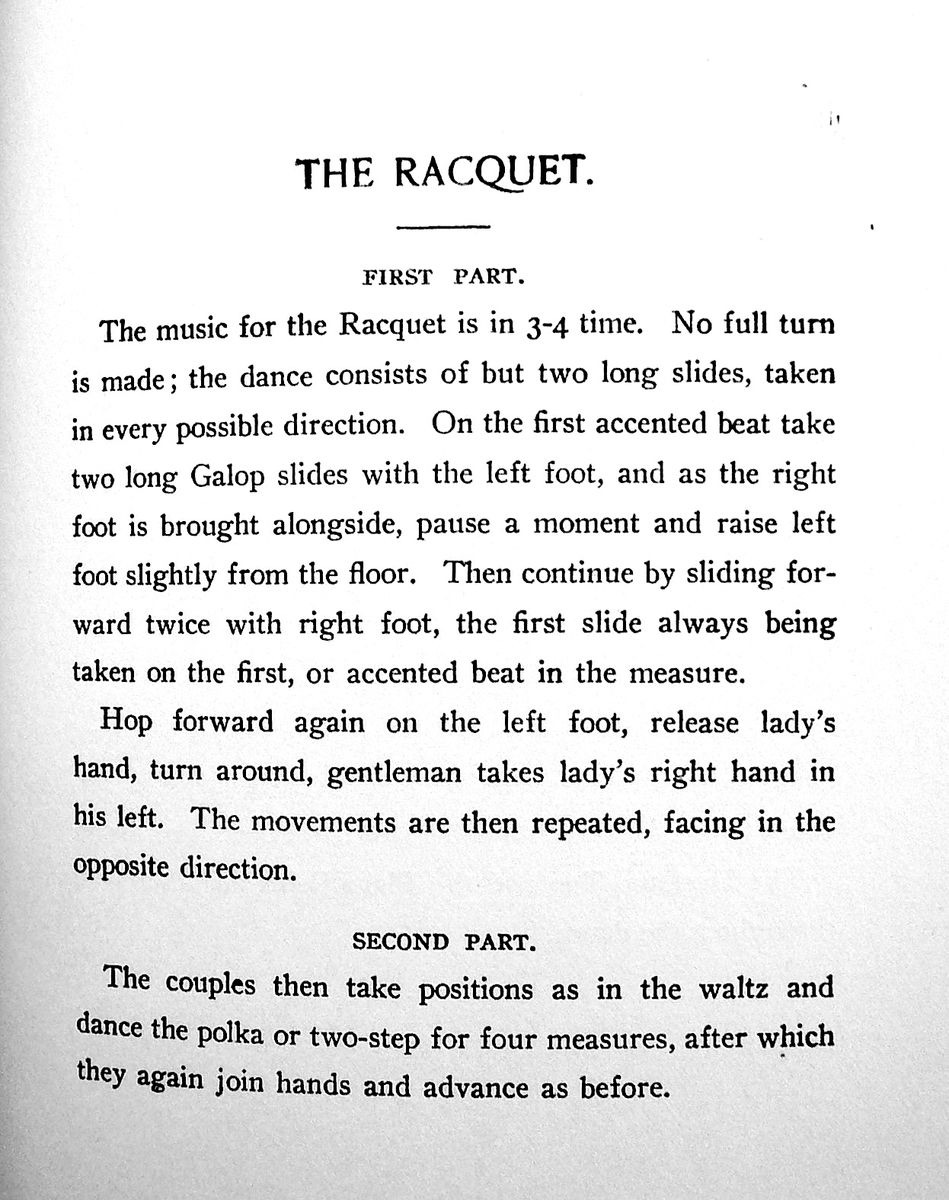
    WilkRacquetWritten on the Trans-Siberian Railroad somewhere between Novosibirsk and Moscow.  Just had to mention that!

    At left is a page from a dance manual published in Philadelphia in 1904: Dancing Without an Instructor, by one Professor Wilkinson.  This is one of the challenges I gave to the students in my just-completed reconstruction class in Novosibirsk.  Could they reconstruct this version of the racket?

    If you want to test yourself with it, click the image to enlarge it, but before diving into the technical details of the dance, take a step back mentally and read through the instructions as a whole.  Notice anything weird?

    You should.

    Don’t click through to the rest of the post until you think you’ve got it.

    (more…)

  • Thinking in Fives

    I spent a lot of time thinking about quintuple-meter (5/4 or 5/8 time) dances earlier this year, though not much of it showed up on Kickery at the time.  Since historical dance description and terminology are not standardized, there’s an important distinction to keep in mind for all dances with some association with the number five:

    Five steps (or movements) in a dance do not necessarily imply 5/4 or 5/8 time.

    (more…)
  • End-of-fellowship thoughts

    I wrapped up my New England Regional Fellowship at the end of May, and other than a few loose research ends that I will be making more library trips this summer and fall to wind up, I've mostly completed the initial stage of my cotillon project: gathering lots and lots of cotillons so that I have enough of them to make some meaningful analysis of the genre. 

    (more…)

  • Thoughts on stepping the Grand Chain in Regency quadrilles

    It’s not unusual for new sources to turn up that make me go back and reconsider a reconstruction.  It’s a little irritating for it to happen less than a month after I finally get around to publishing one here on Kickery, and doubly irritating for it to be not a new source but old sources I simply hadn’t looked at recently.  Fortunately, this is less a change in my reconstruction than further background and options.

    In reconstructing the fourth figure of the Mid-Lothians, an early 1820s quadrille, I wrote in my reconstruction notes that “I’ve never found any description of what step sequence to use for this figure,” referring to the grand chain.  Actually, I had come across such, many years ago, and they had simply slipped my mind.  But I was looking through quadrille sources for a different project and found them again, so here is a little more information about performance options for the grand chain.

    (more…)

  • Wrestling with Belle Brandon

    (Note: since this post was written, I’ve expanded my research on this figure and written a follow-up post, Revisiting Chassé Out, which discusses further sources and slightly alters my conclusion about the performance of the chassé out figure.)

    Recently my English friend and fellow dance teacher/reconstructor Colin Hume asked on the English Country Dance mailing list for help on some American dances he plans to teach later this month at a festival.  He posted his notes (the final version is now up here) and asked for advice, since he’s not a specialist on historical American dance.  I do a lot with quadrilles (French, American, English, Spanish, etc.) so I pounced on the challenge of the 1858 set he proposed to use, the Belle Brandon Set.  This five-figure quadrille is drawn from Howe’s Ball-Room Handbook (Boston, 1858) by Massachusetts dancing master and music publisher Elias Howe.

    (more…)