
Category: Half & Half

  • Half & Half: Seven Steps

    “Seven steps” is actually something of a misnomer for this variation, which actually involves eight steps taken over two measures of half and half (5/4) time.  Its original source, Frank H. Norman’s Complete Dance Instructor (Ottawa, 1914) lists it only as step “No. 2” (out of two) for the half and half.  The Half and Half section of Norman’s book is credited to George E Rutherford.

    The basic principle of the step is to take a single slow hesitating step, lasting three counts as usual (1-2-3), and then take seven quick steps on the last two beats of the first measure and all five beats of the second (4-5-1-2-3-4-5).  Like the five-step variation, this is a very “busy” step that is best done to a very gentle tempo of half and half music.

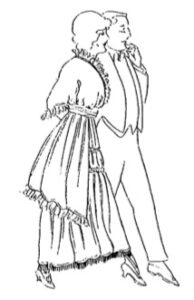
    (more…)

  • Half & Half: Pivot Turns

    “If you wish to spin you must do so on the slow step, continuing forward on the last two counts.”        — from Modern Dancing by Vernon & Irene Castle, 1914

    One of the basic half and half steps which I did not cover in my long-ago post on basic traveling steps for the dance was the pivot turn, as distinct from turning waltz in half and half time.  There aren’t all that many sources for half and half, so it’s mildly (very mildly) significant that this step is mentioned three different times.  There’s the Castles’ succinct description quoted above.  There’s a mention of it in a list of steps, or possibly a choreography, where it is given without any detail as “No. 3. pivot turn, right and left, 8 measures.”  (from “Half and Half” by J. E. Miles, in Dance Mad or the Dances of the Day, 2nd edition, F. Leslie Clendenen (editor), 1914.)  And there’s a full description as part of a mini-sequence which doesn’t actually work.  Here’s the relevant part:

    THE PIVOT TURN is made by stepping L. to side.  C. 1.
    Pivot 1/2 on ball of L.  C. 2. 3.  Walk forward. 4. 5.

    (from “Half and Half” as taught by Castle Assistants, in Dance Mad or the Dances of the Day, 2nd edition, F. Leslie Clendenen (editor), 1914.)

    (more…)

  • Thinking in Fives

    I spent a lot of time thinking about quintuple-meter (5/4 or 5/8 time) dances earlier this year, though not much of it showed up on Kickery at the time.  Since historical dance description and terminology are not standardized, there’s an important distinction to keep in mind for all dances with some association with the number five:

    Five steps (or movements) in a dance do not necessarily imply 5/4 or 5/8 time.

    (more…)
  • Half & Half Variations: A Complex Hesitation

    Wrapping up my little half & half miniseries, here's a wacky little sequence that throws in everything but the kitchen sink: a hesitation, travel, turning, and a change of lead foot.  This is from the Quinlan Twins description of the half & half in the 1914 compilation Dance Mad, second edition.  The only name given it is the deceptively bland "Seventh Figure".

    The sequence is unusual in two other ways as well: odd and even measures have different rhythm patterns, and it appears that both measure have no step on the fifth count, an unusual departure from the standard 1…4,5 half & half rhythm pattern.  All of this makes it not particularly beginner-friendly.

    (more…)

  • Half & Half Variations: The Scissors

    Here’s a nifty little variation for the half & half, as offered by the Castle Assistants in 1914: the scissors.

    To quickly recap: the half & half is danced in 5/4 time, with the dancers taking three steps (on beats 1, 4, and 5) to each measure of music.  There is a lengthy hesitation on the second and third beats.  A more detailed description may be found in my earlier post on basic traveling steps for the half & half.

    Dancing the scissors
    The scissors begin with the gentleman’s back to line of dance, his right foot free.  He crosses right behind (1), hesitates in the usual half & half style (23), then makes two more steps along the same diagonal toward the wall, left-right (45), turning 90 degrees at the end to prepare for the repeat.  On the next measure, he crosses left behind and travels toward the center.  The lady dances on the opposite feet and always crosses in front on the first beat of a measure.  The dancers should meander gently along the line of dance as they cross back and forth.

    (more…)

  • Half & Half: Switching the Lead Foot

    I touched briefly in a previous post on half & half variations on how to easily change the lead foot in this dance, but since the technique applies to other variations as well (and to other dances, for that matter), I thought I would break it out into its own little post.

    The two classic ways to switch the lead foot are to either add a step or subtract one.  Subtraction works especially beautifully with the gentle sway of the half & half, and in the 1914 Quinlan Twins description of the dance, it is explicitly recommended:

    On counts 4 and 5 of 8th measure, take one step with left foot and pose, leaving right pointed in 2nd position.

    (more…)

  • Half & Half: Varying the Promenade

    An easy way to liven up the half & half, the 5/4 waltz of the mid-1910s, is to vary the promenade. 

    In the basic half & half promenade (previously described here), the dancers take ballroom hold and both face line of dance, gliding forward side by side with half & half step patterns (1…4-5, 1…4-5). 

    The second edition of the 1914 compilation Dance Mad offer two easy ways to vary this promenade:

    In the Quinlan Twins' description of the half & half, the eighth figure is a more elaborate promenade that alternates dips and foot lifts:

    123    Step forward (gent's left/lady's right) and dip to the floor
    45      Walk forward two steps
    123    Step forward (gent's right/lady's left) and raise free foot to 4th position forward
    45      Walk forward two steps

    (more…)

  • Half & Half Variations: The Scroll

    Winding up this month's little half and half miniseries, here's another variation from the Castle Assistants, as published in Dance Mad in 1914.  This one even has a name, the scroll, as well as a number ("Step 2").  It's essentially a slow-motion grapevine step changing once per bar rather than on every beat, very similar in conception to the 1930s "about face waltz" described here, which has the pattern of one bar of traveling followed by one bar to change the direction each dancer is facing, with the lady and gentleman always facing opposite directions.

    The scroll uses the basic half and half step sequence (stepping on the first, fourth, and fifth beats of each bar) done in promenade position, as described in my half and half overview here, with the dancers facing opposite directions and traveling for two bars before pivoting.  The change of direction occupies only a partial bar rather than the full bar of the about face waltz.

    (more…)

  • Five Steps in the Half and Half

    • Era: 1910s

    Among the variations listed for the half and half in the 1914 collection Dance Mad is an interesting waltz which, unusually for the half and half, involves stepping on all five beats of the bar rather than on the usual first, fourth, and fifth beats.  It doesn't have a name; the description is simply labeled "Sixth Figure" and is one of eight figures credited to "Quinlan Twins."  For lack of any better name, I refer to it as the five-step variation.

    Background information and basic traveling steps for the half and half may be found in my previous post here.

    (more…)

  • The Half & Half: Basic Traveling Steps

    • Era: 1910s

    The half and half, a hesitation waltz danced in 5/4 time, was one of those novelties that appeared and vanished quickly in 1914.  There may be as many people alive now who know how to dance it as ever danced it in its own era!  It is also handicapped by having very few surviving pieces of music in the right time signature.  Today’s experienced historical social dancers can probably hum the eponymous “Half and Half” from memory.  Sources describing the dance are equally difficult to come by; I have only three in my collection, though one of them, Dance Mad, generously provides four separate descriptions.

    Click here to listen to a half and half tune in 5/4 time.

    (more…)