Category: Foxtrot

  • Early Foxtrot: The Zig-Zag

    I don’t usually write about foxtrot in November, but I don’t usually teach foxtrot in Ukraine in the middle of a war, either, and last month, the dancers of Kyiv’s Vintage Dance Community wanted something for foxtrot that I hadn’t previously described here on Kickery.  Here is the description for their future reference and that of others interested in the variations for the foxtrot of the 1910s.

    ~~~~~~~~~~~~~~~~~~

    At least two versions of a zig-zag sequence appeared in short booklets published in 1914 and 1915:

    • The Zig-Zag Step and “Trot”: Joan Sawyer’s How to Dance the Fox Trot (Columbia Graphaphone Company, New York,1914)
    • The Zig-Zag Run: Description of Modern Dances as Standardized by the New York Society Teachers of Dancing and approved by the Congress of Dancing Societies of America at meeting held December 27th, 1914, in New York City, N. Y. (American National Association Masters of Dancing, Pittsburgh, 1915)

    Sawyer characterized the figure as a “hard one” but also “loads of fun”.  Her description:

    (more…)
  • Early Foxtrot: the St. Denis Spiral

    While thinking about mixing foxtrot and maxixe

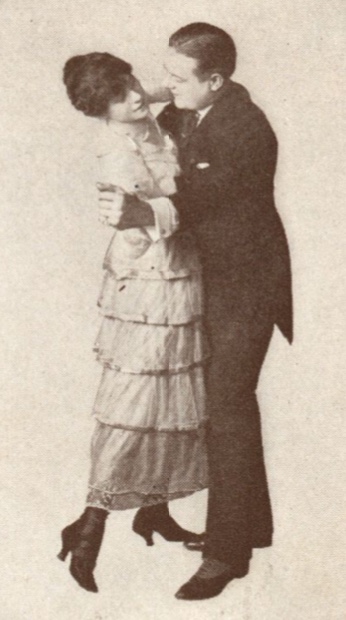
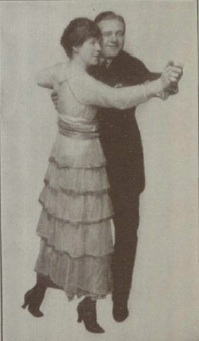
    The St. Denis Spiral is a minor foxtrot variation from Edna Stuart Lee's Thirty Fox Trot Steps (New York, 1916) which, like the sequences in my previous post, incorporates maxixe styling in the two-step.  Like Lee's Pavlowa Extension, it is named for a famous dancer, in this case Ruth St. Denis.  I am not a scholar of modern dance (theatrical or otherwise), so I have only the most superficial knowledge of her career, but apparently she was indeed noted for incorporating spiral figures, as may be seen in "The Delirium of Senses" from Radha (1906), recorded at Jacob's Pillow in 1941.  I seriously doubt she had anything to do with this foxtrot variation, however; the name is most likely just an homage.

    The sequence is just as easy as the other foxtrot-maxixe combinations:

    (more…)

  • Early Foxtrot: a bit of maxixe

    Maxixe in the foxtrot?  They mixed bits and pieces of every other dance of the ragtime era together, so why not jazz up your foxtrot with a little body sway?

    At least two different sources suggest using maxixe-styled two-step in the foxtrot: Joan Sawyer’s How to Dance the Fox Trot (Columbia Graphaphone Company, New York,1914) and Description of Modern Dances, as Standardized by the New York Society Teachers of Dancing and approved by the Congress of Dancing Societies of America at meeting held December 27th, 1914, in New York City, N. Y. (American National Association Masters of Dancing, Pittsburgh, 1915).

    I’ll start with Sawyer, since her booklet (dated November 23, 1914), is chronologically earlier.  Her foxtrot figures all consist of a pattern of a unique step or sequence followed by eight trotting steps.  Her third figure, the Maxixe-Glide and “Trot”, starts with four measures of “Maxixe two-step” done moving along the line of dance (gentleman forward, lady backward) without turning.  The two-steps begin with the gentleman’s left foot, lady’s right; feet then alternate as usual

    (more…)
  • Early Foxtrot: The Minuet Turn

    Keeping with the foxtrot theme, here's one more little sequence for foxtrot or one-step from Edna Stuart Lee's Thirty Fox Trot Steps (New York, 1916).  Despite its overt simplicity, it actually manages to present a minor reconstruction issue!  As for the name…well, to be perfectly honest, I see absolutely no connection here to the minuet, any more than I do with Newman's Minuet Tango.  There seems to have been some concept of "minuet" in the 1910s which I have completely failed to grasp.

    The gentleman's steps are given; the lady dances opposite.  The dancers begin in normal ballroom hold, the gentleman facing forward along line of dance and the lady backward.

    (more…)

  • Early Foxtrot: The Pavlowa Extension

    For no reason other than habit, June is always foxtrot month for me, and despite the general shutdown of dance classes, I’m lucky enough to have a convenient partner at hand for experimentation with new variations.  So let’s look at yet another of the many step-sequences described in Edna Stuart Lee’s Thirty Fox Trot Steps (New York, 1916)!

    The Pavlowa Extension was, of course, named for the famous ballerina Anna Pavlowa (Pavlova), who toured America in the mid-1910s and dipped into social dance choreography with a music-composition contest resulting in a trio of dances published in The Ladies’ Home Journal in early 1915.  She (or her ghostwriter) and (supposedly) members of her troupe also offered opinions and suggestions about dancing the one-step, Boston, and foxtrot.  This variation, however, is not among those even indirectly associated with Pavlova.  It probably was merely named in her honor, or perhaps was inspired by a characteristic movement in her dancing.

    (more…)

  • Early Foxtrot: Quick Dips

    Ah, June, when one turns one's thoughts (and feet) to…weird little foxtrot variations! 

    This time around, let's look at a pair of steps, or rather step-sequences, from Edna Stuart Lee's Thirty Fox Trot Steps (New York, 1916) that both involve quick dips.  These are actually ever-so-slightly harder to do than the usually run of walks, trots, glides, and two-steps that make up a great deal of the 1910s foxtrot repertoire.  Lee noted that the first of these, The Coney Island Dip, is "very exhilarating and excellent exercise for the lungs."

    The gentleman's steps are given; the lady dances opposite.

    (more…)

  • Early Foxtrot: Catch Steps

    I spent a lot of time teaching foxtrot this spring, and after going through my usual repertoire of easy foxtrot variations with several different groups, I feel I need to add a few new steps.  Nothing complicated, just something to spice up my standard set.  Both of these steps are taken from Edna Stuart Lee's Thirty Fox Trot Steps (New York, 1916).

    The basic catch step is just a simple way to change the lead foot, either because it's needed for a variation or just for fun.  It's so easy I can explain it without a little numbered chart: 

    Gentleman starts left forward.  Walk for awhile.  When you want to change lead foot, make a single two-step.  Keep walking with the lead (odd count; the strong beat of the music) on the other foot.  The lady does the same thing, but backward and starting on the right foot.

    More formally:

    (more…)

  • Early foxtrot: the drag step

    It’s been quite some time since I’ve written up any early foxtrot variations, so here’s a simple but stylish one from 1914 to add to your repertoire!

    Dancer Joan Sawyer, owner of the Persian Gardens nightclub in New York City, called this the “drag step”, but unlike the drag or draw steps found in other dances of the late nineteenth and early twentieth centuries, the feet are not just closed heel to heel.  Instead, the closing foot is tucked behind (his) or in front of (hers) the other.  Here’s Sawyer’s description of the drag step and the following “trot”, with the accompanying illustration at left:

    The gentleman slides the left foot out to his left as though he were going to walk sideways.  He then drags his right foot over back of the heel of the left foot, coming up slightly on the toes at the end of the movement, and breaks into a forward “trot” of four steps, gentleman starting the first trot step with is left foot…The lady you see slides her right foot out to her right, she then points the toe of her left foot over in front of her right foot, throwing her weight on to the left foot, then trots backward four steps, sliding the right foot back first.

    (more…)
  • Early Foxtrot: The Castle Favorite

    Along with the standard early variations that come up repeatedly in the 1910s, there are also numerous little foxtrot variants that turn up only once and were probably not generally popular.  Despite the name, the "Castle Favorite", presumably a reference to the famous ballroom dancers and teachers Vernon and Irene Castle, does not turn up in any source I have that is actually by the Castles.  Instead, it appears in Edna Stuart Lee's Thirty Fox Trot Steps (New York, 1916), a wonderful little source for unusual early foxtrot variations.  I don't necessarily rule out a connection with the Castles, but given how creative Lee was with variation-names, I am not taking it as a given without some actual proof.

    Lee calls this a "rather difficult step, requiring considerable practice and possibly not adapted to ordinary social dancing".  That seems an exaggerated level of concern to me; it's not difficult to dance or to lead, and I see no reason not to include it in social dancing other than it being too uncommon to bother learning.

    (more…)

  • One for the ponies!

    I've been waiting for most of my life for another horse to win the Triple Crown, and, much to my chagrin, when it finally happened I was working and therefore missed seeing it live even on television, let alone indulging my secret hope to one day see such a thing in person.  Arrgh!

    I will console myself by free-associating to a foxtrot variation: the Cavalry Charge!

    The first thing to be aware of is that Edna Stuart Lee, in her Thirty Fox Trot Steps (New York, 1916), calls the following sequence "The Pony Trot" and claims that it was the original foxtrot step:

    1234    Four walking steps
    1&2&  Four trots

    (more…)