
Category: Country Dance

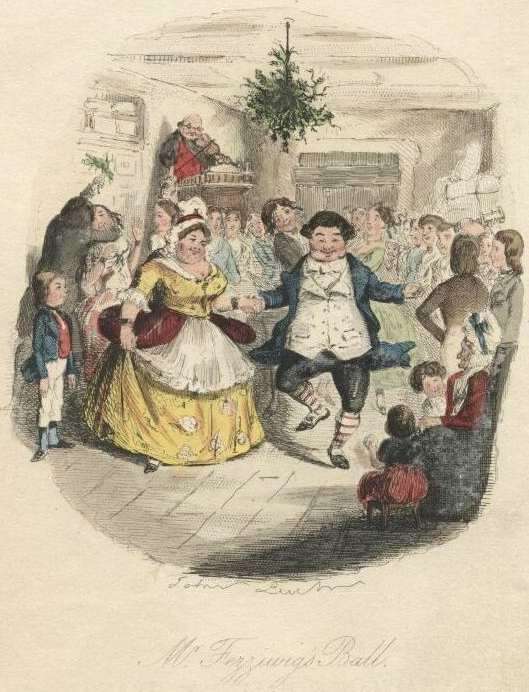
  • Mr. Fezziwig’s Ball

    “In came a fiddler with a music-book, and went up to the lofty desk, and made an orchestra of it, and tuned like fifty stomach-aches.”

    So begins the famous description of Mr. Fezziwig’s Christmas Eve ball in Charles Dickens’ 1843 novel, A Christmas Carol, the full text of which with the original illustrations, including the one shown at left (click to enlarge), may be found at Project Gutenberg.

    This is a fun example of, at least, a Victorian writer’s conception of a late 18th century ball which, though given by a successful businessman, is very much of the middle and lower classes rather than of the nobility.  Given that Dickens’ family was not wealthy (at one point they ended up in a debtors’ prison), he may have been writing more from personal experience in London in the 1830s than, say, careful research about ballroom practices several decades earlier. So while this is a useful historical document for dance history, which period it is useful for is not entirely clear.

    (more…)

  • Down East Breakdown

    • Era: late 1850s-1860s, America (New England)

    Down East Breakdown is an unusual Civil War-era American contra dance: unlike most of them, it is done in “mescolanze,” or four-facing-four, formation.  I have directions for it only in two manuals by Boston musician Elias Howe: Howe’s Complete Ballroom Handbook (Boston, 1858), and American Dancing Master and Ball-Room Prompter (Boston, 1862).  Unlike many contra dances of the mid-century, it does not seem to have been picked up by later writers.

    The name of the dance is rather interesting.  “Down east,” in a New England context, refers to eastern Maine.  A “breakdown” in this era was a type of solo dance, like clogging, which was particularly associated with slave dancing and minstrelsy, as may be seen in works like Jig, Clog, and Breakdown Dancing Made Easy (New York, 1873).  An illustration at the American Antiquarian Society website, taken from the January 31, 1863, edition of Frank Leslie’s Illustrated Newspaper, shows “contraband children” dancing a breakdown.  The dance itself does not incorporate any kind of stepping or anything other than perfectly typical figures, however.

    (more…)

  • Bricklayer’s Hornpipe

    • Era: 1850s-1890s, America (New England)

    Here’s an easy American contra dance of the Civil War era found in three Boston sources.  Two are manuals by Elias Howe: Howe’s Complete Ballroom Handbook (Boston, 1858), and American Dancing Master and Ball-Room Prompter (Boston, 1862); the third is Professor L.H. Elmwell’s Prompter’s Pocket Instruction Book (Boston, 1892).

    The figures for the dance, as given by Elmwell:

    First couple cross over inside below second couple (4); Up on the outside and turn partners to places (4); First couple down the centre, back and cast off (8); First lady swing second gent (4); First gent swing second lady (4); Right and left (8).

    The earlier instructions from the two manuals by Howe are virtually identical except that he describes the second move as “up on the outside swing partner to place”, a distinction I will address below, and the swings of the first lady/second gentleman and first gentleman/second lady as “quite round”.

    (more…)

  • Harvest Home

    • Era: American, late 1850s-early 1860s

    In commemoration of the American Thanksgiving holiday, here’s a seasonally appropriate dance from the American Civil War era, a country dance for a set of six couples.

    While I have not done a comprehensive search, I appear to have instructions for “Harvest Home” only in a pair of dance manuals by Elias Howe: Howe’s Complete Ballroom Handbook (Boston, 1858) and American Dancing Master and Ball-Room Prompter (Boston, 1862), which include far more country dances than is typical of other dance manuals of the time period.  New England to this day retains a stronger country dance tradition, in the form of modern contra dance, than most other parts of the United States.

    (more…)
  • Right & left: hands or not?

    By the mid-nineteenth century, the only American dance manuals that contain large quantities of contradances are those from the New England area.  Others may have a few here and there, but not the pages and pages of them, or entire manuals of nothing but contras.  And, alas for reconstructors looking back 150 years later, the authors simply don’t bother to explain how to do specific figures.  Presumably, everyone knew.

    For most figures this isn’t a particular problem; they’re self-evident from the name or unchanged from earlier eras.  But there is one figure that is especially ambiguous to dance historians, and that is “right and left” or “rights and lefts”.  The major reason for the ambiguity is good old Thomas Wilson, a dancing master in early nineteenth-century London and a prolific author.  Wilson wrote some of the most useful books on English country dance in all of dance history, with explanations, diagrams, and occasionally even steps for each figure.  But he had a somewhat unusual take on right and left.

    (more…)

  • Gothic Ancestry: A Country Dance Gallopade

    • Era: 1830s, England

    A year or so ago I published a discussion and reconstruction of the 1862 country dance gallopade known as The Gothic Dance and mentioned that there was a very similar dance in London dancing master J. S. Pollock’s c1830 manual, A Companion to La Terpsichore Moderne (Second Edition).  I’ve taught this dance at the few 1830s events I’ve had an opportunity to run, but have not previously published a reconstruction.

    The original instructions for the dance, one of a pair of country dance gallopades with numbers but no titles, are as follows:

    No. 2.     (4 parts) 

        All advance, retire, and cross over, changing places with partners — advance, retire, and cross over back again — first and second couples right and left — first couple gallopade down the middle to the bottom of the dance, and remain at the bottom.

    (more…)

  • Go Figure!

    At our recent Regency Assembly, one of the dancers challenged my call of a “half figure eight” in a country dance, asking why it wasn’t called a “figure four”.  Casey, being an experienced dancer, knew exactly why, but he has excellent comic timing, and the comment broke up the room for a moment.

    A geekier question would be why I was using the term “half figure eight” rather than the more typical plain “half figure”.  That was for added clarity for modern dancers, who may not be as familiar with the nuances of Regency terminology, in which a sentence like “The figure of the dance is a double figure made up of five figures, the first being the figure” makes perfect sense.  Since it doesn’t for everyone, let’s figure out all those different usages of “figure”!

    Although every Country Dance is composed of a number of individual Figures, which may consist of “set and change sides,” “whole Figure at top,” “lead down the middle, up again,” “allemande,” “lead through the bottom,” “right and left at top,” &c. yet the whole movement united is called the Figure of the Dance.
    — Thomas Wilson, in The Complete System of English Country Dancing, London, c1815.

    (more…)

  • What Did Jane Austen Dance?

    Since early 19th century (“Regency”) dance is one of my particular specialties, I get many questions that boil down to either “what did Jane Austen dance?” or “did Jane Austen dance _____?”  So let’s see what I can do for a general answer.

    I can divide things loosely into three categories: what we know she danced, what she might have danced, and what she didn’t dance.

    (more…)

  • A Regency “Sir Roger de Coverley”

    In honor of the season…

    In his Complete System of English Country Dancing, published circa 1815, Regency-era dancing master Thomas Wilson proclaimed of the dance “Sir Roger De Coverley” that it was

    composed expressly for a finishing Country Dance, about 100 years ago, and derived its name from Addison’s Sir Roger De Coverley; so frequently mentioned by him in his popular Essays in the Spectator, and is the only whole Dance given in this System. The Figures of which it is composed being permanent and unalterable, and thereby differing in its construction from all other Country Dances.

    and explained its use as the final dance of the evening (or early morning, given the length of balls of the era):

    At all Balls properly regulated, this Dance should be the finishing one, as it is calculated from the sociality of its construction, to promote the good humour of the company, and causing them to separate in evincing a pleasing satisfaction with each other.

    (more…)

  • Light Dragoon

    • Era: 1850s-1860s America

    “Light Dragoon” is an easy mid-19th century American country (contra) dance, one of a lengthy list of contra/country dances given in two manuals written by Elias Howe.  In one of the two, it is cryptically labeled “Pinkerton;” possibly this is the name of the choreographer of the dance.  It is performed in a longways set of any length, though four to six couples is easiest.  All couples are “proper,” with the men standing to the left of their partners when all are facing the top of the room.

    (more…)