Tag: Victorian dancing

  • Howe’s “Rats” Quadrille, concluded (3 of 3)

    This is the third in a series of three posts discussing the “Rats” Quadrille, with this one covering the fourth and fifth figures.  See the two previous posts for introduction and background and the first three figures.

    (more…)

  • Howe’s “Rats” Quadrille, continued (2 of 3)

    On to the actual figures of Howe’s “Rats” Quadrille!  Please see the first post in the “Rats” series for an introduction to the quadrille and links to sheet music. 

    (more…)

  • Howe’s “Rats” Quadrille (1 of 3)

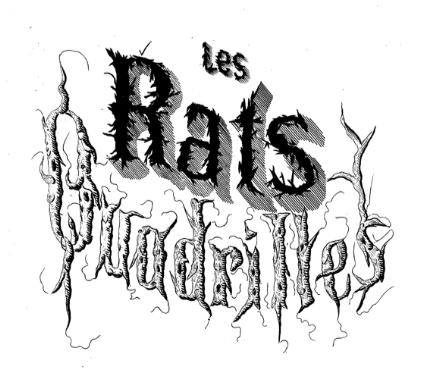
    RatsLogoLes Rats Quadrilles is a set of five tunes composed by G. Redler as alternate music for the first set of French quadrilles. The tunes are unusually good, and the set became enormously popular and was reprinted for many years, not only in England but in America and Australia as well.  In 1854 a  piano-duet (four hands) version arranged by J. C. Vierec was published in Philadelphia.

    Some editions featured the “tree roots” version of the title shown at left, and others a small orchestra of rats with various instruments.  American editions seem to have credited the composer as “J. Redler”, but English sources consistently give his first initial as “G”.

    I do not have a definitive initial date for the first publication of Les Rats, but in 1846, A. M. Hartley, in his The academic speaker, a system of elocution (Glasgow) mentions on page 319 the inclusion of “Redler’s popular Rat Quadrilles” in Volume I of the collected Hamilton’s Cabinet of Music, a sheet music series, which puts Les Rats into the first half of the 1840s.

    (more…)

  • A Promiscuous Figure: The Sociable

    “This is a very lively figure, as it keeps all the couples occupied and introduces a continual change of partners.”

        — Dick’s Quadrille Call-Book and Ball-Room Prompter, New York, 1878.

    I’ve posted occasionally about promiscuous figures (Basket and Star, Gavotte and Minuet, Flirtation), single quadrille figures which may be substituted for one of the figures of the first set of quadrilles to provide more variety.  Another of these, which dates at least to 1848, was known variously as “The Sociable,” “Quadrille Sociable,” or “Social Quadrille.”  Its distinctive feature was repeated partner changes.  As noted above, it also had the virtue of having very little waiting out for any of the couples.  While Charles Durang, writing in Philadelphia in 1856, sniffed at it as one of the “good, but now unfashionable” old figures, it seems to have remained popular right through the middle of the nineteenth century and is even included in a few manuals appearing into the late 19th and very early 20th century.

    Different dancing masters disagreed about which figure of the first set this or other promiscuous figures may be substituted for.  One 1878 manual stated that substitution is done for the second or fifth figure, while an 1889 one is equally clear that the third and fourth figures are the ones to replace.  My personal opinion is that the Sociable is stylistically most like a fifth figure.

    Thomas Hillgrove, writing in 1857, seems to have been the first to build an entire quadrille around the Sociable, using it as figure one in a traditional five-figure set called the “Quadrille Sociable.”  Six years later, he includes it in a later manual as “Social Quadrille No. 1.”  A similar five-figure quadrille is included in a manual attributed to Elias Howe and published in 1862.  Unfortunately, the five-figure version is not particularly interesting, just one of many interchangeable rearrangements of generic quadrille figures.  This may explain why it doesn’t seem to have been picked up by many other authors.

    The Sociable by itself, however, is a fun little figure, easy to teach and fun to do.  Here’s the basic version:

    (more…)