
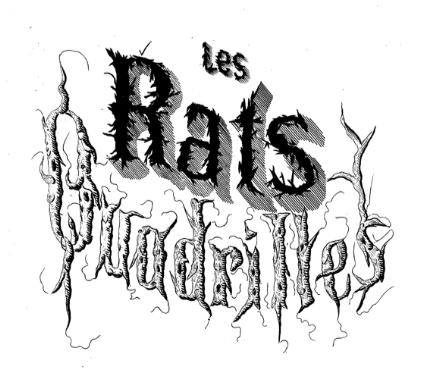
 Les Rats Quadrilles is a set of five tunes composed by G. Redler as alternate music for the first set of French quadrilles. The tunes are unusually good, and the set became enormously popular and was reprinted for many years, not only in England but in America and Australia as well. In 1854 a piano-duet (four hands) version arranged by J. C. Vierec was published in Philadelphia.
Some editions featured the “tree roots” version of the title shown at left, and others a small orchestra of rats with various instruments. American editions seem to have credited the composer as “J. Redler”, but English sources consistently give his first initial as “G”.
I do not have a definitive initial date for the first publication of Les Rats, but in 1846, A. M. Hartley, in his The academic speaker, a system of elocution (Glasgow) mentions on page 319 the inclusion of “Redler’s popular Rat Quadrilles” in Volume I of the collected Hamilton’s Cabinet of Music, a sheet music series, which puts Les Rats into the first half of the 1840s.