Category: Sequence Dances

  • La Marjolaine

    La Marjolaine, The New Society Dance, was published by the White-Smith Music Publishing Co. in 1888. The music was “arranged from an Italian theme” by Pierre Duvernet with an accompanying “combination of figures” by E. W, Masters. The title page of the sheet music may be seen below; click to enlarge.
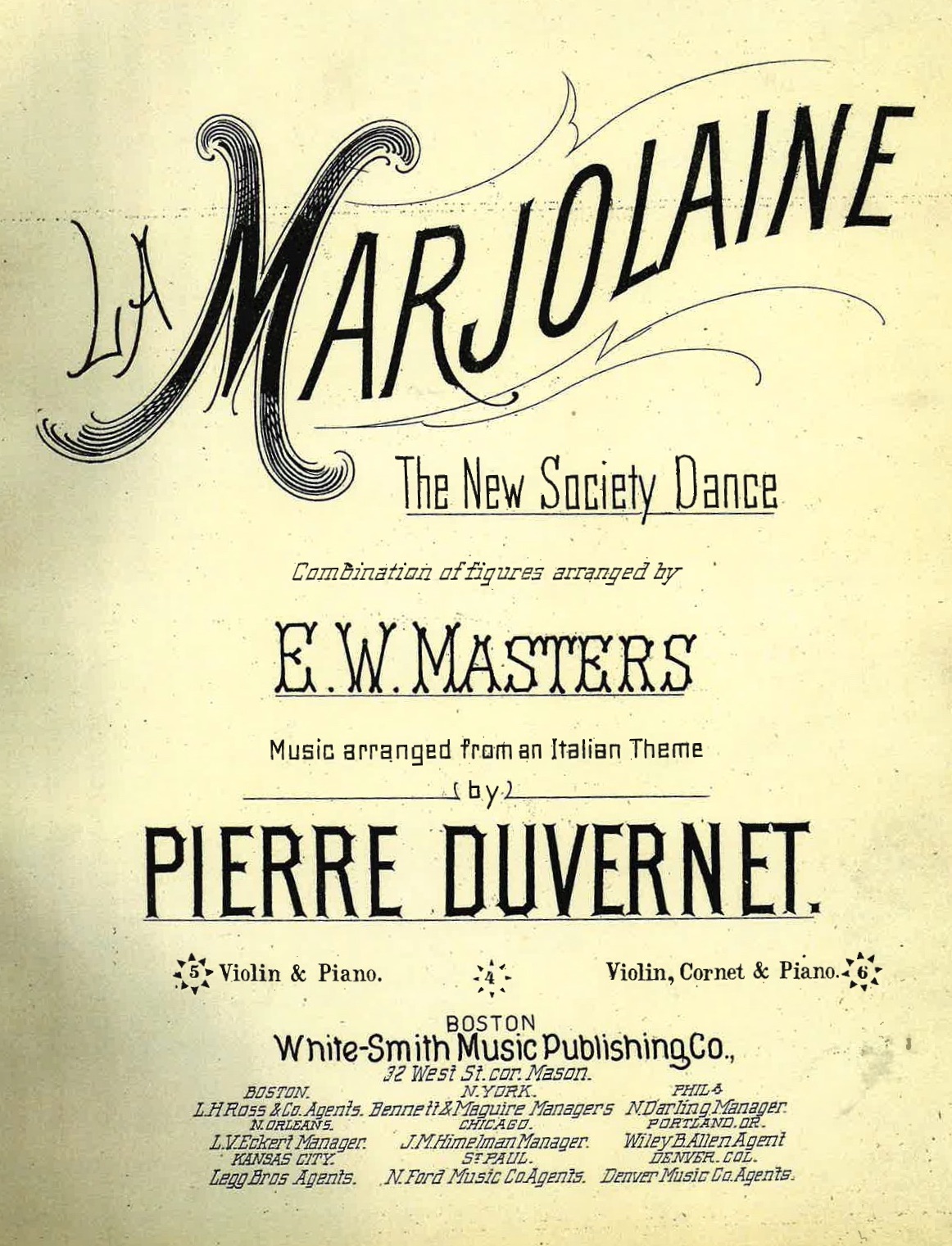
    The figures are a very simple eight-bar sequence: a typical late nineteenth century variant of the “heel and toe” polka combined with the four-slide galop. Although the dance is clearly a two-step, complete with music in 6/8, that term is never used in the instructions – an interesting hint that the two-step was not yet well-known as a term in 1888 as it would become in the 1890s.

    (more…)

  • Zebley’s Tango

    Moving right along with my tiny tango post series, here's another sequence from F. Leslie Clendenen's two editions of Dance Mad (St. Louis, 1914).  This one is simply called "Tango" and was provided by T. Victor Zebley, a Washington, D.C., dancing master.  It isn't really a "tiny" tango; it's a full thirty-two measures, which is enough for a full-fledged sequence dance.

    Zebley's tango is very straightforward to reconstruct and, provided one remembers the full sequence, easy to dance, with three points where the dancers can make some minor choices of their own.  I give my preferences, but also describe the other options in the performance notes below.

    (more…)

  • “Tango No. 1”

    Continuing on with the tiny traveling tango sequences from 1914, here’s one that’s a bit less tiny than the Two-Step Tango.  “Tango No. 1” is listed in both editions of Dance Mad (St. Louis, 1914) with the note “As taught in our classes.”, which presumably meant the classes of F. Leslie Clendenen’s own academy.  That means that this is as much a class practice sequence as a social dance.  As I reconstruct it — and see the reconstruction notes below — it is a reasonable sixteen bars (thirty-two beats) in length, and suitably easy for a class, as it only involves four basic moves – walking, a spin turn, draw steps, and grapevine.

    The starting position is a closed ballroom hold with the gentleman’s back to line of dance and the lady facing line of dance.  The gentleman starts on the left foot, the lady on the right.  Steps are given for the gentleman; the lady dances opposite.

    (more…)

  • Two-Step Tango

    The Two-Step Tango is an anonymous eight-bar sequence published in the first and second editions of F. Leslie Clendenen's compilation Dance Mad (St. Louis; both editions 1914).  There are several of these tiny "tango" sequences that travel decorously around the room without much tango feel to them — see the similar Butterfly Tango and Dixie Swirl.  These short progressive sequences all appeared in the first edition, along with the somewhat better-composed and more tango-like ones (including a "Tango Two-Step") from Albert Newman.  The impression I get from this is that the more authentic tango was still making its way across the country in early 1914, so the authors of these sequences were still interpreting it as "slow one-step to tango music".  The second edition of Dance Mad expanded the tango section enormously, retaining the short sequences but adding twenty-two pages of more authentic Argentinian and Parisian tango steps.

    (more…)

  • The Rag-Time Crawl

    I semi-jokingly call the Rag-Time Crawl “the dance for when I get tired of the Castle Schottische”.  It basically fulfills the same function: easy to dance, accessible to beginners, and comforting to people who are not up to leading and following and enjoy the Macarena-like effect of everyone moving all together in the same pattern.

    My source for the dance is Frank H. Norman’s Complete Dance Instructor (Ottawa, 1914).  The author is J. B. McEwen of Glasgow, Scotland.  I don’t know a lot about either of these gentlemen, but I can offer a few bits of trivia:

    (more…)

  • Sorority Glide

    Most of the steps in Dance Mad (St. Louis, 1914) were collected by “author” F. Leslie Clendenen from other dancing masters, but he gives himself credit for the Sorority Glide, a sixteen-bar one-step sequence that he recommends be danced to “Too Much Mustard” or “any One Step music of a similar swing.  It’s a fun little sequence with a very “Castles” feel to it and room for some personal style.  It works as an independent dance or can be plugged into a regular one-step as a variation.

    The dancers begin in a ballroom hold, turned out slightly so both face line of dance.  The dancers need to be far enough apart to make a cross step without crowding.  Weight should be shifted onto the forward (outside) foot, the gentleman’s left and the lady’s right, since the dance starts on the inside foot.

    (more…)

  • Dixie Swirl

    The Dixie Swirl is a short tango-ish sequence found in F. Leslie Clendenen's compilation Dance Mad (St. Louis, 1914).  While it is not actually in the tango section and doesn't really have much of a tango feel, the brief description states that it is to be done to tango music.  It is attributed to Mrs. Nantoinette Ohnmeiss, about whom I've not been able to discover any information.

    The sequence appears at first glance to be eight bars, which is really too short to be interesting:

    2b    Gallop four times along line of dance (slide-close x4)
    2b    Two-step (presumably a full turn)
    4b    Swirl (the spin turn described here)
    Repeat from the beginning

    (more…)