Category: March/Polonaise

  • Polish Dance, 1832

    This blandly named "Polish Dance" was published by expatriate English dancing master William George Wells in The danciad, or companion to the modern ball room in Montreal in 1832.  I have my doubts about whether there is anything authentically Polish about it, but the dance itself is…interesting.  Let me start with a transcription.

    ~~~~~~~~~~~~~~~~~~~~~~

    POLISH DANCE

        To be danced by an unlimited number of couples, and placed exactly in the same situation as for the Original Gallopade.

    (more…)

  • Double Grand Chain (a march or cotillion figure)

    I first came across Double Grand Chain when flipping through Twentieth Century Cotillion Figures, by H. Layton Walker (Two Step Publishing Company, Buffalo, New York, 1912) for interesting cotillion (dance party game) figures.  Like Winthrope, Double Grand Chain is not terribly game-like beyond the basic cotillion setup of dancing with one person and then finding a new partner, but it would make an interesting addition to a grand march for a group of reasonably skilled dancers.

    Double Grand Chain was not original to Walker; it also appeared in all the editions of Allen Dodworth’s Dancing and its relations to education and social life running from 1885 to 1913 (the link is to the 1900 edition), which puts it firmly in the “late Victorian” category.  Since it did reappear in 1912 separately from the Dodworth reprints, I’d still consider it legitimate for a ragtime-era event, and it is sufficiently innocuous in style that I wouldn’t be bothered by its use at a mid-nineteenth-century event either.

    (more…)

  • A Valentine Cotillion

    I return once more, in honor of Valentine’s Day, to H. Layton Walker’s delightful Twentieth Century Cotillion Figures (Two Step Publishing Company, Buffalo, New York, 1912), which is always guaranteed to provide me some interesting figures for imaginative dancers.  Christmas was a bit disappointing, as holiday cotillion themes go.  Valentine’s Day seems much more promising, since both cotillions and valentines have the goal of matching up people and thus ought to combine nicely!

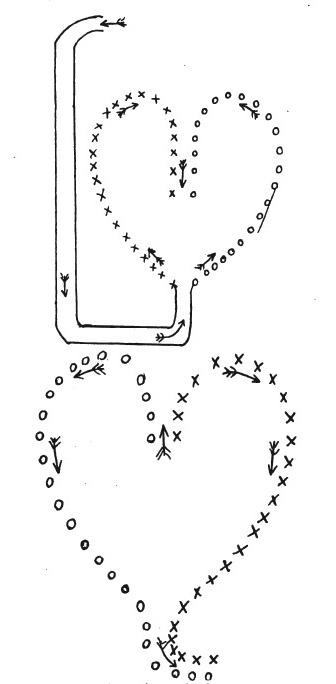
    Starting from the top of an evening’s program, Walker does provide a couple of useful suggestions for the grand march.  I noted a few years ago that good leaders could get their marching dancers into formations such as the letters of the alphabet, or other geometric figures.  Hearts, for example, lend themselves easily to being both created and escaped from by lines of dancers.  Walker provided the diagrams at left for what he called a “Heart March Cotillion”, though the shape is so basic that one hardly needs the help.

    (more…)

  • Ending a Grand March

    In almost seven years of writing Kickery (has it really been that long?) I think I’ve only once said anything at all detailed about the Grand March, which was generally performed as the opening dance at American balls in the latter part of the nineteenth century and well into the twentieth, though occasionally it appears later on the program.  Clearly an overview is overdue!

    This isn’t it.

    While working recently on the ball program for a pair of Civil War-era balls to be held in Gettysburg in November, I started wondering idly how many ways there were to end a Grand March.  So I made a little list.  I won’t be using most of these, alas; the Gettysburg balls are insanely crowded and thus do not lend themselves to really interesting Marches.  But I thought it might be fun to share some of the possibilities.

    (more…)