Category: Books

  • The Morrisons, 1863

    I came across Margaret Hosmer’s novel, The Morrisons: a story of domestic life (1863), in my endless quest for dance references in nineteenth-century fiction.  Almost four hundred pages later, I have a few new citations, the highlight of which is a mention of two women waltzing together, and a growing distaste for storylines that treat dying of consumption (tuberculosis) as a character-building experience.

    According to Deidre Johnson’s useful website 19th-Century Girls’ Series, which catalogues said series and their authors, only basic biographical facts about Hosmer’s life are known: she was born Margaret Kerr in 1830, raised in Philadelphia, married Granville Hosmer and had at least one child, bounced back and forth between Philadelphia and California several times, worked in schools, published novels and short fiction for both children and adults, and died in 1897.  The website’s full biographical listing for her, from which these details are taken, may be found here.  I am not enough of a fan of her writing to have done any further research on her life.
    (more…)
  • Reminiscences, 1865

    I have what seems like an endless collection of works of nineteenth-century women’s fiction that I plow through for the dance references whenever I have the chance.  Most of them are overly sentimental and laden with heavy-handed moral messages.  “Reminiscences”, which was serialized in the American women’s periodical Godey’s Lady’s Book from February to June, 1865, was no exception to this, alas, but at least it was relatively short.

    The background of the piece is a bit of a mystery.  The author is the same “Ethelstone” credited with “Dancing the Schottische” (Godey’s, July 1862), which I discussed a few years ago.  I’ve never been able to locate any information about this author.  And “Reminiscences” adds a new element of confusion because it is written in first person and purports to be the story of one Ethel Stone.  Was “Ethelstone” actually a woman named Ethel Stone?  Is this fiction masquerading as memoir?  Or part of an actual memoir of a life that oh-so-conveniently included the elements of a mid-nineteenth-century morality tale?  That seems unlikely, so I assume that it’s fiction.  But I may never know for certain.

    (more…)

  • A Ballroom Repentance, 1882

    Annie Edwardes’ two-volume novel, A Ballroom Repentance (London: Richard Bentley & Sons. 1882), was apparently a somewhat racy novel by Victorian standards.  By today’s, it falls into that dreary research category of deservedly-obscure novels that I plow through for the dance scenes.

    Edwardes (c1830-1896) was an English author successful enough to publish twenty-one novels between 1858 and 1899, the last published posthumously.  Three were adapted for theatre.  I haven’t read any of her other books, but the title of this one attracted me, since it promised a ballroom scene which might have include some useful tidbits of dance information.  The ballroom scene comes very near the end, but to be thorough, I read all seven hundred or so pages of what it would be fair to call Victorian soap opera.  It’s a quick read with fewer words per page than a modern novel, so that wasn’t quite as tedious as it sounds, but I can see why Edwardes has not come down to us as a major writer.  

    (more…)

  • Irving’s Christmas Sketches, 1820

    For Christmas Day, let’s return to Washington Irving’s The Sketch Book of Geoffrey Crayon, Gent., looking this time at the fifth number, published in America on January 1, 1820, and covering the English celebration of the Christmas holidays. The description of the old-fashioned English Christmas at the fictional Bracebridge Hall was based on Irving’s personal experience at Aston Hall in the late 1810s and, as is well-known to scholars and obvious even to the casual reader, was a major influence on Charles Dickens when he came to write A Christmas Carol.

    Four of the five sketches in the fifth number contained dance references. I’ll take them one by one, skipping over the first sketch (“Christmas”) which merely provides an overview of the excitement of celebrating the Christmas holyday [sic] in England. Page numbers reference the London second edition of 1820.

    (more…)

  • Mr. Fezziwig’s Ball

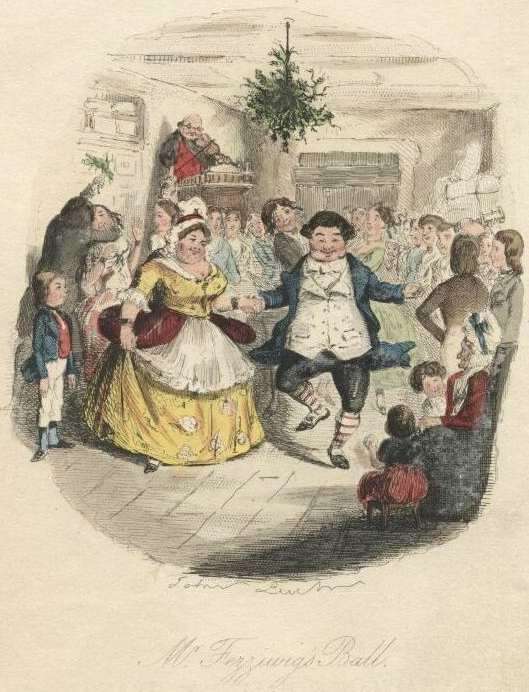
    “In came a fiddler with a music-book, and went up to the lofty desk, and made an orchestra of it, and tuned like fifty stomach-aches.”

    So begins the famous description of Mr. Fezziwig’s Christmas Eve ball in Charles Dickens’ 1843 novel, A Christmas Carol, the full text of which with the original illustrations, including the one shown at left (click to enlarge), may be found at Project Gutenberg.

    This is a fun example of, at least, a Victorian writer’s conception of a late 18th century ball which, though given by a successful businessman, is very much of the middle and lower classes rather than of the nobility.  Given that Dickens’ family was not wealthy (at one point they ended up in a debtors’ prison), he may have been writing more from personal experience in London in the 1830s than, say, careful research about ballroom practices several decades earlier. So while this is a useful historical document for dance history, which period it is useful for is not entirely clear.

    (more…)