This is the third in a series of three posts discussing the “Rats” Quadrille, with this one covering the fourth and fifth figures. See the two previous posts for introduction and background and the first three figures.

Capering & Kickery
Susan de Guardiola, Social Dance Historian
Welcome to the original-format Capering & Kickery blog! Due to the Typepad shutdown in September and the resultant move to WordPress, the entire post archive is not yet available, as each post must be individually edited (formatting, images, music, videos, links, etc.) and indexed before it is restored. Please check back regularly over the next few months to see the progress in rejuvenating the blog!
Note: in the restored posts below, most of the internal links (to other Kickery posts) will remain down until the linked post is also restored. If you have a request to prioritize a particular post or set of posts, please contact me at the email above!
-
Howe’s “Rats” Quadrille, continued (2 of 3)
On to the actual figures of Howe’s “Rats” Quadrille! Please see the first post in the “Rats” series for an introduction to the quadrille and links to sheet music.
-
Howe’s “Rats” Quadrille (1 of 3)
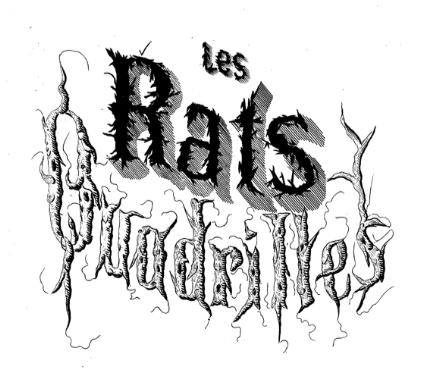 Les Rats Quadrilles is a set of five tunes composed by G. Redler as alternate music for the first set of French quadrilles. The tunes are unusually good, and the set became enormously popular and was reprinted for many years, not only in England but in America and Australia as well. In 1854 a piano-duet (four hands) version arranged by J. C. Vierec was published in Philadelphia.
Some editions featured the “tree roots” version of the title shown at left, and others a small orchestra of rats with various instruments. American editions seem to have credited the composer as “J. Redler”, but English sources consistently give his first initial as “G”.
I do not have a definitive initial date for the first publication of Les Rats, but in 1846, A. M. Hartley, in his The academic speaker, a system of elocution (Glasgow) mentions on page 319 the inclusion of “Redler’s popular Rat Quadrilles” in Volume I of the collected Hamilton’s Cabinet of Music, a sheet music series, which puts Les Rats into the first half of the 1840s.
-
Thoughts on stepping the Grand Chain in Regency quadrilles
It’s not unusual for new sources to turn up that make me go back and reconsider a reconstruction. It’s a little irritating for it to happen less than a month after I finally get around to publishing one here on Kickery, and doubly irritating for it to be not a new source but old sources I simply hadn’t looked at recently. Fortunately, this is less a change in my reconstruction than further background and options.
In reconstructing the fourth figure of the Mid-Lothians, an early 1820s quadrille, I wrote in my reconstruction notes that “I’ve never found any description of what step sequence to use for this figure,” referring to the grand chain. Actually, I had come across such, many years ago, and they had simply slipped my mind. But I was looking through quadrille sources for a different project and found them again, so here is a little more information about performance options for the grand chain.
-
Late Victorian Waltz Variations: Fascination
Fascination is another of the myriad minor waltz variations given by dancing master M. B. Gilbert, in his Round Dancing (Portland, Maine, 1890), who includes the dance “by permission of D. B. Brenneke”, presumably the creator. It is essentially a longer and slightly more complex elaboration on the Gavotte Glide.
Gilbert’s description reads:
First Part:–Slide left foot to side (2d), 1, 2; draw right to left, placing weight on right, 3; one measure. Repeat one measure. Slide left to side, 1, 2; draw right to left and slide left to side (chassé), & 3; one measures. Draw right to left and slide left to side, & 1, 3; draw right to left, placing weight on right. 3; one measure.
Second Part:–Waltz four measures. Recommence at first part.
Counterpart for lady.
The dancers are in standard waltz position, the gentleman facing the wall. The lady dances the same moves on opposite feet.
-
La Russe
(Note 6/3/24: I’ve written a follow-up to this post; the link is at the end. My reconstruction stands.)
I picked La Russe out some time ago while looking for easy late nineteenth century waltz-time variations. The name means “the Russian woman”, and I recently had the pleasure of teaching it in Moscow to a very talented group of Russian dancers.
No specific choreographer is known for La Russe, but we can date it with unusual precision to just over 130 years ago. Dancing master M. B. Gilbert, in his Round Dancing (Portland, Maine, 1890), noted that it was “introduced by the American Society of Professors of Dancing, New York, May 1st, 1882,” and it turns up in a couple of other American dance manuals of the 1880s. All the descriptions are quite consistent, though the terminology used varies.
-
Late 19th Century Jig-Time Dances: The Bronco
Like the Rockaway, the Bronco is another dance listed under the “Miscellaneous” category in M.B. Gilbert’s Round Dancing (Portland, Maine, 1890) as suitable for either jig time (6/8) or galop time (2/4).
Please see my earlier post on the Rockaway for a discussion of jig and galop rhythms and a sample of jig music.
Original description
Leap backward from the right to left foot, 1; leap backward upon the right foot, 2; leap backward upon the left, 3; pass right to side and immediately draw left to right (à la Newport), & 4; pass right to side and draw left to right, & 5; leap forward upon the right, 6; pass left to side and draw right to left, & 7; pass left to side and draw right to left, & 8; four measures. Repeat, commencing as at first. The second time the right foot may move backward at the sixth count, making the turn to the left. Counterpart for lady.
— Gilbert, Round Dancing, p.165 -
Late 19th Century Jig-Time Dances: The Rockaway
I’ve recently been looking more closely at some of the “Miscellaneous Dances” found in the back of M. B. Gilbert’s 1890 tome, Round Dancing, and noticed that quite a few of the dances there are labeled specifically as for dancing to jig time (6/8) or for either jig or galop (2/4) time. The Rockaway is one of those given as suited for either time signature.
The earliest source I have for this dance is a New York dance manual, and it seems likely that it was named for the Rockaway Peninsula, a part of Long Island which was a popular seaside resort area in the nineteenth century. The description in Gilbert is considerably clearer and is the basis for this reconstruction.
-
CD Review: Returning Heroes
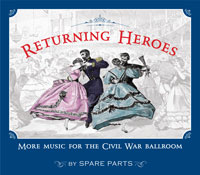 Brand new this month — the release party is coming up in a couple of weeks — is the dance band Spare Parts‘ latest CD of mid-nineteenth-century dance music, Returning Heroes. After dancing for many years to music from their earlier CD, The Civil War Ballroom, it’s a delight to have new music for this era!
The short review: it’s a great CD; buy it immediately if you enjoy dancing of the Civil War era.
The longer version follows.
Disclaimer: the musicians of Spare Parts are personal friends, and my advance copy of this CD was sent to me as a gift.
-
Down East Breakdown
- Era: late 1850s-1860s, America (New England)
Down East Breakdown is an unusual Civil War-era American contra dance: unlike most of them, it is done in “mescolanze,” or four-facing-four, formation. I have directions for it only in two manuals by Boston musician Elias Howe: Howe’s Complete Ballroom Handbook (Boston, 1858), and American Dancing Master and Ball-Room Prompter (Boston, 1862). Unlike many contra dances of the mid-century, it does not seem to have been picked up by later writers.
The name of the dance is rather interesting. “Down east,” in a New England context, refers to eastern Maine. A “breakdown” in this era was a type of solo dance, like clogging, which was particularly associated with slave dancing and minstrelsy, as may be seen in works like Jig, Clog, and Breakdown Dancing Made Easy (New York, 1873). An illustration at the American Antiquarian Society website, taken from the January 31, 1863, edition of Frank Leslie’s Illustrated Newspaper, shows “contraband children” dancing a breakdown. The dance itself does not incorporate any kind of stepping or anything other than perfectly typical figures, however.