Author: Susan de Guardiola

  • Thoughts on teaching polka and polka redowa

    I recently had the opportunity to watch another teacher do a general introduction to the standard mid-nineteenth century couple dances.  That’s a rarer event than you’d imagine.  Historical dance teachers aren’t that thick on the ground, and even at multi-teacher festivals, either there aren’t any introductory classes or I’m busy teaching my own classes during them.

    Watching this class reminded me of something I’ve been meaning to write up for months about altering how we teach this repertoire.  This doesn’t apply to the one-night-stand sort of teaching gig, but I think it’s something other teachers with ongoing classes may find useful.

    (more…)

  • The Dip Schottische

    The Dip Schottische is one of the minor schottische sequences created by dancing masters in the early 1910s.  In this case, the author was one I. C. Sampson, of Lynn, Massachusetts, and the dance was published in both the first and second editions of F. Leslie Clendenen’s compilation Dance Mad (St. Louis, 1914).  Unfortunately, the dance instructions have one major ambiguity that makes it very difficult to come to a definitive reconstruction: what, exactly, does “turn” mean?  Here’s the original language for one move in the dance:

    “One Step” turn (pivot, four steps, two measures)

    The problem is that there is no single “one step turn”.  There are at least two very plausible candidates: the spin and the traveling turn, better known today as pivots.  If I had to guess which would be the “one step turn”, I’d guess the spin, but there are some problems with that in regard to this particular sequence.  But there are problems with the traveling turn as well.  Here’s some of what I considered when trying to choose between them:

    (more…)

  • Early Foxtrot: The Castle Favorite

    Along with the standard early variations that come up repeatedly in the 1910s, there are also numerous little foxtrot variants that turn up only once and were probably not generally popular.  Despite the name, the "Castle Favorite", presumably a reference to the famous ballroom dancers and teachers Vernon and Irene Castle, does not turn up in any source I have that is actually by the Castles.  Instead, it appears in Edna Stuart Lee's Thirty Fox Trot Steps (New York, 1916), a wonderful little source for unusual early foxtrot variations.  I don't necessarily rule out a connection with the Castles, but given how creative Lee was with variation-names, I am not taking it as a given without some actual proof.

    Lee calls this a "rather difficult step, requiring considerable practice and possibly not adapted to ordinary social dancing".  That seems an exaggerated level of concern to me; it's not difficult to dance or to lead, and I see no reason not to include it in social dancing other than it being too uncommon to bother learning.

    (more…)

  • We have a problem here…

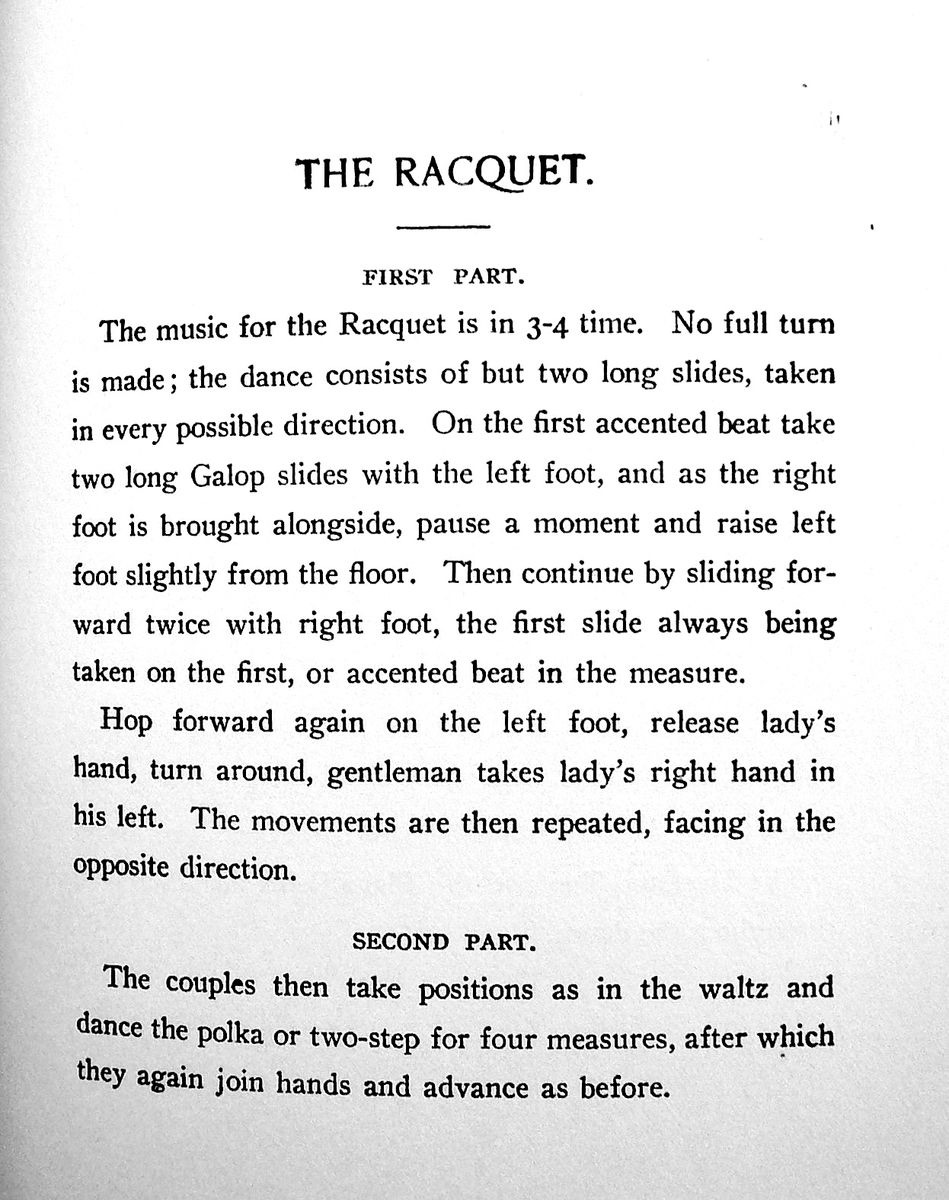
    WilkRacquetWritten on the Trans-Siberian Railroad somewhere between Novosibirsk and Moscow.  Just had to mention that!

    At left is a page from a dance manual published in Philadelphia in 1904: Dancing Without an Instructor, by one Professor Wilkinson.  This is one of the challenges I gave to the students in my just-completed reconstruction class in Novosibirsk.  Could they reconstruct this version of the racket?

    If you want to test yourself with it, click the image to enlarge it, but before diving into the technical details of the dance, take a step back mentally and read through the instructions as a whole.  Notice anything weird?

    You should.

    Don’t click through to the rest of the post until you think you’ve got it.

    (more…)

  • Mr. Faurot’s Hesitation Waltz

    This hesitation waltz sequence by Seattle dance teacher George G. Faurot (c1879-1954) was published in both editions of F. Leslie Clendenen’s compilation Dance Mad (St. Louis, 1914).  Faurot himself was a native of Lima, Ohio, where his uncle Ben discovered oil and his brother Lee eventually became mayor.  Faurot Park in Lima was donated by Ben and is named for him.

    According to George’s obituary, he fought in the Spanish-American War and then had a career in the oil industry before moving to Seattle, where he ran the Faurot Studio of Dancing with his wife, Nellie, for thirty years.  The Faurots’ residence in the late 1930s is now a historical site in Seattle.  The building that housed their dance studio, the Oddfellows Building, still stands and is still home to a dance studio, Century Ballroom, though the Faurot Ballroom itself seems to have been in the first-floor space which is now the Oddfellows Cafe.

    Interestingly, Lee, before becoming mayor, also seems to have dabbled in dance teaching before ending up in the insurance business and politics.  A family passion?

    (more…)

  • One for the ponies!

    I've been waiting for most of my life for another horse to win the Triple Crown, and, much to my chagrin, when it finally happened I was working and therefore missed seeing it live even on television, let alone indulging my secret hope to one day see such a thing in person.  Arrgh!

    I will console myself by free-associating to a foxtrot variation: the Cavalry Charge!

    The first thing to be aware of is that Edna Stuart Lee, in her Thirty Fox Trot Steps (New York, 1916), calls the following sequence "The Pony Trot" and claims that it was the original foxtrot step:

    1234    Four walking steps
    1&2&  Four trots

    (more…)

  • Snowball fight!

    In honor of tonight’s incoming blizzard, and because I’ve been thinking lately about cotillion figures that scale up well for large groups, let’s talk about Les Boules de Neige.  For those who don’t speak French, that would be…The Snowballs!

    (more…)

  • Dancing Mormons

    I come across little tidbits of information about dance history in the oddest places.

    The Church of Jesus Christ of Latter-Day Saints, better known as the Mormon church, places a premium on genealogical research for theological reasons.  This has inspired one Mormon family, the Blakes, to create a website about their immediate ancestors.

    Among the reminiscences on their site is an interesting excerpt from the book In Search of Zion: King, Youngberg and Allied Families by Richard K. Hart, which apparently features the recollections of one James King, a friend of Blake ancestor Walter Frank Blake (1880-1965).

    According to the information on the Blake family site, Walter Blake was born in England and immigrated to Utah with his parents at the age of two.  His mother converted to the Mormon faith in the 1880s and Walter and his siblings followed suit.  The King family, already Mormons, were neighbors and friends.  James King recounted his memories of life in turn-of-the-century Utah farm country to his wife in 1959.  Though the stereotype of Mormons is rather stuffy, apparently social dancing was (and is) allowed and even encouraged, provided that it doesn’t get too intimate or suggestive.

    King’s stories of life near Utah’s Great Salt Lake include a wonderful glimpse of rural dancing  around 1900:

    (more…)
  • A dancing master’s epitaph

    From a book of “select and remarkable” epitaphs published in 1757:

    On Mr. Maddox, a Dancing-Master, and his Wife.
    They were lovely and pleasant in their Lives, and in
    their Deaths they were not divided.
    Hail happy Pair!  predestin’d long to prove
    The chastest Raptures of connubial Love!
    Who took no Step thro’ Life’s perplexed Dance,
    But what would well your mutual Bliss advance!
    Who figur’d not a Plan but what was meant,
    Again to join your Hands with fresh Content.
    Tho’ ceremonious–yet with Ease still fraught;
    The very Image of the Art you taught !
    Polite in all Life’s mazy Measures try’d,
    As the gay Partner to his destin’d Bride.
    Twice thirty Years in gentle Wedlock past,
    The first was not so happy as the last !
    Still each to each so complaisantly gay,
    As raptur’d Lovers on their Nuptial Day !
    All wing’d with Down their Years advancing roll,
    And still improve this Unison of Soul!
    Unvarying–courtly to his latest Breath,
    He gave his Spouse Precedence e’en in Death.
    The truest Honours to each other given,
    He just surviv’d, then led her up to Heaven.

    (more…)

  • Fox Trot Hats

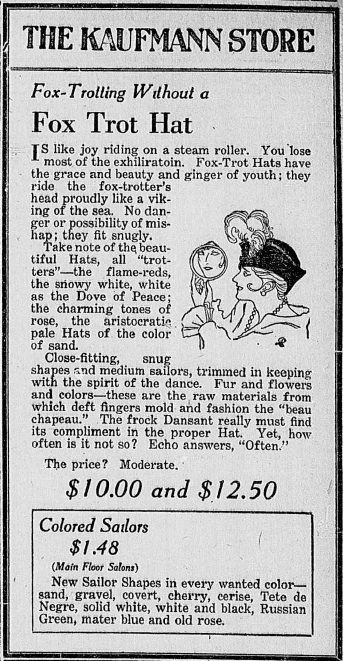
    I’ve been looking for something amusing to wind up the centennial year of the foxtrot, and I found it in the November 17, 1914, issue of The Richmond Times-Dispatch: some fashion advice for the foxtrotting ladies in the store advertisement shown at left:

    Fox-Trotting Without a Fox Trot Hat
    is like joy riding on a steam roller.

    How do I follow up a line like that?  I can only suggest reading the rest of the ad (click to enlarge) for more delightfully fulsome language.

    For historical dancers, this is a reminder that during the 1910s, dancing in a hat at an afternoon thé dansant was perfectly proper, though judging by the advertisement, either not everyone agreed or not everyone succeeded in finding a suitable hat:

    (more…)