
Author: Susan de Guardiola

  • “agoing to dance the spanish dance”

    “…George Cowls says tell Nancy he is right in his glory to day and when he comes home he is agoing to dance the spanish dance with you and he says tell Abby he is agoing through ceders swamp with her…”
               — Pvt. Jairus Hammond to Nancy Titus, December 8, 1862

    Here’s rare documentation of a specific dance: a mention in a letter from a Union soldier during the American Civil War to his sister, dated one hundred and fifty-two years ago today, that another man plans to dance the Spanish Dance (previously described here) with her when he returns.  There has been no real doubt that the Spanish Dance was actually danced and was as popular as its frequent appearance in dance manuals suggests.  I have found it listed on dozens of dance cards.  But this is another little piece of documentation demonstrating that its popularity extended well down the social scale.
    (more…)

  • The Yale Schottische, 1895

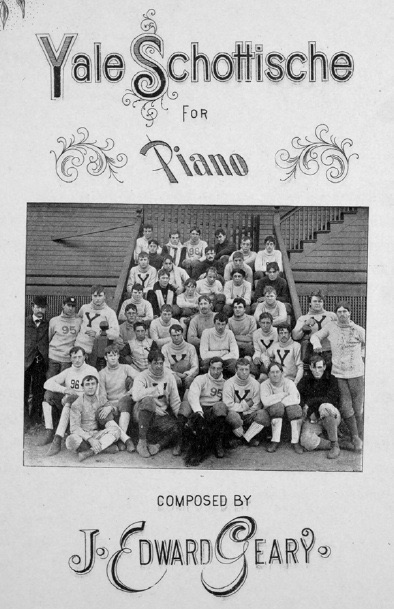
    As previously noted, I always have an eye out for dances named after Yale University and Yale-related dance ephemera.  Walking through the campus earlier today on my way to a meeting reminded me that I had another Yale-themed dance to discuss: the Yale Schottische, which was published with the eponymous sheet music in 1895 and dedicated to the Yale University Football Association.  Yale has one of the oldest football programs in the world and was a regular national title winner in the late nineteenth and early twentieth century.  Some of the players pictured at left (click to enlarge) are probably among the several Yalies of the 1890s chosen as All-Americans or inducted into the College Football Hall of Fame.  (More details about Yale’s place in football history may be found here.)

    (more…)

  • A Montréal Gavotte, 1918

    The classic schottische of the mid-nineteenth century and its later incarnation, the Barn Dance (a.k.a. the Military Schottische and the Pas de Quatre) had mostly faded from fashionable ballrooms by the late 1910s.  But a few very simple schottisches or schottische-like sequences turn up now and then in dance manuals and on sheet music of the 1910s, often under the name “gavotte”, a musical form with the same 4/4 meter characteristic of the schottische.

    La Gavotte is a short sequence taken from Professor A. Lacasse’s La Danse apprise chez soi, published in Montréal in 1918.  There were many dances called “gavotte” in the late nineteenth and early twentieth centuries, not all of them in 4/4 time, so while this particular gavotte may have been locally popular in Montréal, it should not be considered any sort of definitive gavotte for the 1910s or any other era.

    (more…)

  • A 3/4-time grapevine sequence, 1914

    I’ve had sequence dances on my mind recently after some discussion earlier this week, which reminded me of this little sequence from the the second edition of F. Leslie Clendenen’s 1914 compilation Dance Mad.  It appears there under the name “American Grapevine Dance” by Anthony J. Giaconia of Springfield, Massachusetts.  I know nothing about Mr. Giaconia except that on June 24, 1912, he was quoted on the front page of The Indianapolis News as one of a convention of dancing masters appalled by dances like the Grizzly Bear and Bunny Hug.  He found some dancing in a park there so disgraceful that it ought to be stopped “for the sake of decency”.

    The Grapevine Dance is so short (only eight bars) that it doesn’t feel long enough to be a sequence dance all on its own, but the two measures in which the dancers move directly into the center of the room and back make it mildly risky to use simply as a variation; moving abruptly back and forth across the line of dance can cause problems for dancers coming up behind.  Doing this from an “inside lane” near the center of the room will be more polite if it is not being done in unison as a sequence dance.

    (more…)

  • Battle Confetti

    One hundred and sixteen years ago today, the magazine Harper’s Bazaar published a brief blurb predicting fashionable dances for the winter would be of “military tone”, no doubt influenced by the burst of patriotic fervor occasioned by the brief Spanish-American War, which by the autumn of 1898 had moved into peace negotiations.  The article gives a quick peek at what dances interested Americans (or, at least, American dancing masters) in the second-to-last winter of the nineteenth century.

    Unsurprisingly, the writer acknowledges the “extraordinary popularity” of the two-step.  The five-step schottische is called a “new” schottische, which is inaccurate, since it had been around since at least 1890, when it was included in M. B. Gilbert’s Round Dancing, and possibly as early as 1871 under a different name.  The dance may have been receiving a fresh push from the assembled masters of The American Society of Professors of Dancing, whose meeting seems to have spurred this little notice.  No other couple dances are mentioned.

    (more…)

  • Ending a Grand March

    In almost seven years of writing Kickery (has it really been that long?) I think I’ve only once said anything at all detailed about the Grand March, which was generally performed as the opening dance at American balls in the latter part of the nineteenth century and well into the twentieth, though occasionally it appears later on the program.  Clearly an overview is overdue!

    This isn’t it.

    While working recently on the ball program for a pair of Civil War-era balls to be held in Gettysburg in November, I started wondering idly how many ways there were to end a Grand March.  So I made a little list.  I won’t be using most of these, alas; the Gettysburg balls are insanely crowded and thus do not lend themselves to really interesting Marches.  But I thought it might be fun to share some of the possibilities.

    (more…)

  • Basic Foxtrots from Edna Lee

    Earlier this year I talked about nine different variations from the handy little booklet Edna Stuart Lee's Thirty Fox Trot Steps (New York, 1916) in two mini-series, starting here (three posts) and here (two posts).  My choice of sequences may have given the impression that Lee's collection was mostly odd little variations with (often) even odder names (Chaplin Trot, anyone?)  That's because I was skipping over the simplest sequences given by Lee, since I have encountered them elsewhere and written about them, or similar sequences, in earlier posts. 

    Here, I'm going to give a quick rundown of eight very basic sequences that Lee included among her more unusual and/or unique ones so that it is clear that there was a certain basic repertoire overlapping what is found in many other sources.

    (more…)

  • A Vauxhall Masquerade (12th Annual Regency Assembly), Saturday, October 18th, New Haven, CT

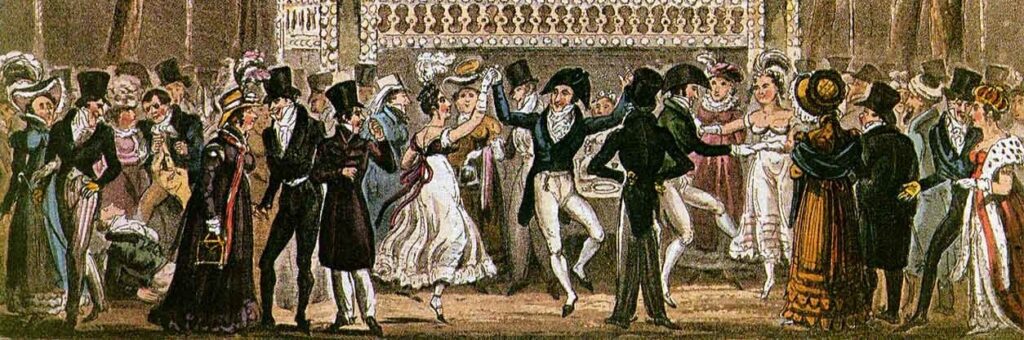
    Saturday, October 18th, in New Haven, Connecticut we will have a night of Regency-era revelry with a masquerade ball in the style of Vauxhall Gardens, the famous pleasure gardens of early 19th century London!  This will be our twelfth annual Regency Assembly in New Haven.

    (more…)
  • September 2014 Gig Calendar

    Back in the saddle after a very productive (and mostly fun) trip to exciting places in August.  September puts me back into my usual teaching routine with classes in New York, Middletown, and Boston; a dance weekend in Chicago; and a side-trip to Canada for a private workshop and some off-the-grid time! 

    I'm still working out my class schedule for the rest of this month, but here are the highlights.  Check back for a few new things toward the end of the month.

    (more…)

  • August 2014 Gig Calendar

    August is vacation month, for my personal definition of vacation that involves a lot of time spent in libraries and talking about dance history and otherwise geeking out.  This is differs from my normal routine of a lot of time spent in libraries and talking about dance history in that the libraries are located and the conversations and geeking out will occur in exciting foreign countries.

    The beginning of the month will have only my routine monthly workshops.  At the end of the month, I have scheduled five days of jet-lagged stupor.  Details of the former:

    (more…)