Category: Civil War (American)

  • Waltzing Around

    A recent mailing list discussion centered on how to quickly teach people to do a "waltz-around", the style of country dance progression in which two couples waltz around each other once and a half times.  This is most famously part of the mid- to late-nineteenth-century Spanish Dance, as well as other American waltz contra dances (such as the German Waltz and Bohemian Waltz).  It dates back at least as far as the late 1810s to early 1820s in England, when Spanish dances were an entire genre of country dances in waltz time, and both they and ordinary waltz country dances featured this figure, sometimes under the names "poussette" or "waltze".  I expect it goes even further back on the European continent, but I haven't yet pursued that line of research.

    As a dancer, the waltz-around has always been one of those figures that I just…do.  I'd observed that it's difficult for beginners to master the tight curvature of the circle and making one and a half circles in only eight measures, but as an experienced waltzer, I've long been able to do it instinctively.  And I'd never broken down precisely what I did or worked out how to explain it to others.  

    So I suppose it's about time!

    (more…)

  • Newport Fancy Dress Ball, 1850

    The final fancy dress of the Newport summer season of 1850 occurred on Wednesday, September 4th.  It was covered by The Boston Herald on September 5th (“Grand Fancy Ball at Newport”, p. 4) and more extensively by The New York Herald on September 6th (“The Grand Fancy Dress Ball at Newport”, p. 1).  The bulk of the coverage was devoted to lists of attendees and their costumes, as is typical for fancy dress balls, but there are some other tidbits of useful information as well.  The New York Herald article is extremely lengthy, so I have not transcribed all of it.  The article from The Boston Herald is quite short, but not nearly as interesting.

    The ball was held at the rebuilt Ocean House, the original of which had opened in 1844, burned down, and been rebuilt.  This Ocean House was not the same as the modern Ocean House in Newport.  A different hotel by the same name opened in 1868, was demolished in 2005, and then rebuilt again in 2010.

    At the RhodeTour website, Dr. Brian Knoth writes about the first two Ocean Houses, with specific mention of the 1850 Fancy Dress Ball:

    (more…)

  • On evening parties with dancing, 1860

    The most fashionable as well as pleasant way in the present day to entertain guests is to invite them to evening parties, which vary in size from the “company,” “sociable,” “soiree,” to the party, par excellence, which is but one step from the ball.

    The entertainment upon such occasions may vary with the taste of the hostess or the caprice of her guests.  Some prefer dancing, some music, some conversations.  Small parties, called together for dramatical or poetical readings, are now fashionable, and very delightful.
    The Ladies’ Book of Etiquette and Manual of Politeness

    I first came across Florence Hartley’s The Ladies’ Book of Etiquette and Manual of Politeness (G. G. Evans: Philadelphia, 1860) via the July, 1861, issue of Godey’s Lady’s Book, which excerpted the section on the etiquette for a lady hosting an evening party.  There is a matching section for the (female) guests at an evening party as well as sections for ladies hosting or attending balls.  I have spent a great deal of time over the years reading about mid-nineteenth century ballroom etiquette, but considerably less on that for more informal events.  I thus found Mrs. Hartley’s thoughts on the subject quite interesting.  It would be fun to host smaller events such as these, if one had both the sizable rooms and the servants that Mrs. Hartley assumes will be available or hired for the night.

    (more…)

  • The Trio

    Since I frequently have to deal with an imbalance in numbers between the ladies and the gentlemen at nineteenth century balls, I’m always interested in dances that use a trio formation.  This can be one gentleman with two ladies or vice-versa, though the former is the more common situation.

    This dance, simply called “The Trio”, appears in at least two editions of Elias Howe’s American dancing master, and ball-room prompter (Boston, 1862 and 1866).  Howe’s instructions are a bit vague and neglect to mention the actual timing of the figures, but a little experimentation convinced me that the following reconstruction is workable and fun.  This is an extremely easy dance, good for groups of beginners.

    (more…)

  • Thoughts on teaching polka and polka redowa

    I recently had the opportunity to watch another teacher do a general introduction to the standard mid-nineteenth century couple dances.  That’s a rarer event than you’d imagine.  Historical dance teachers aren’t that thick on the ground, and even at multi-teacher festivals, either there aren’t any introductory classes or I’m busy teaching my own classes during them.

    Watching this class reminded me of something I’ve been meaning to write up for months about altering how we teach this repertoire.  This doesn’t apply to the one-night-stand sort of teaching gig, but I think it’s something other teachers with ongoing classes may find useful.

    (more…)

  • “agoing to dance the spanish dance”

    “…George Cowls says tell Nancy he is right in his glory to day and when he comes home he is agoing to dance the spanish dance with you and he says tell Abby he is agoing through ceders swamp with her…”
               — Pvt. Jairus Hammond to Nancy Titus, December 8, 1862

    Here’s rare documentation of a specific dance: a mention in a letter from a Union soldier during the American Civil War to his sister, dated one hundred and fifty-two years ago today, that another man plans to dance the Spanish Dance (previously described here) with her when he returns.  There has been no real doubt that the Spanish Dance was actually danced and was as popular as its frequent appearance in dance manuals suggests.  I have found it listed on dozens of dance cards.  But this is another little piece of documentation demonstrating that its popularity extended well down the social scale.

    (more…)

  • Ending a Grand March

    In almost seven years of writing Kickery (has it really been that long?) I think I’ve only once said anything at all detailed about the Grand March, which was generally performed as the opening dance at American balls in the latter part of the nineteenth century and well into the twentieth, though occasionally it appears later on the program.  Clearly an overview is overdue!

    This isn’t it.

    While working recently on the ball program for a pair of Civil War-era balls to be held in Gettysburg in November, I started wondering idly how many ways there were to end a Grand March.  So I made a little list.  I won’t be using most of these, alas; the Gettysburg balls are insanely crowded and thus do not lend themselves to really interesting Marches.  But I thought it might be fun to share some of the possibilities.

    (more…)

  • Tales of the Schottische from Godey’s Lady’s Book

    A comment from one of my Russian correspondents that the schottische was rarely, if ever, danced in Russia in the nineteenth century* started me thinking, after a series of mental jumps**, about how well-accepted (or not) the schottische was in America in its early years.

    There appears to have been some dissension on the merits of the dance after its introduction to America around 1849.  Edmund Ferrero claimed in The art of dancing (New York, 1859) that the schottische had “acquired great favor”, and all the major dance manuals from the end of the 1850s onward include it.  But the anonymous author of Beadle’s dime ball-room companion and guide to dancing (New York, 1868) claimed that the schottische was considered “vulgar”.  Since it appeared regularly on dance cards from at least the late 1850s all the way into the early twentieth century, that can’t have been a universal opinion.  But was it really anyone’s other than, presumably, those of ministers and others who condemned dancing altogether?

    (more…)

  • CD Review: Returning Heroes

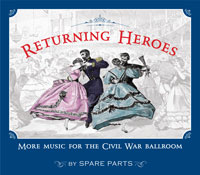
    Brand new this month — the release party is coming up in a couple of weeks — is the dance band Spare Parts‘ latest CD of mid-nineteenth-century dance music, Returning Heroes.  After dancing for many years to music from their earlier CD, The Civil War Ballroom, it’s a delight to have new music for this era!

    The short review: it’s a great CD; buy it immediately if you enjoy dancing of the Civil War era.

    The longer version follows.

    Disclaimer: the musicians of Spare Parts are personal friends, and my advance copy of this CD was sent to me as a gift.

    (more…)

  • Harvest Home

    • Era: American, late 1850s-early 1860s

    In commemoration of the American Thanksgiving holiday, here’s a seasonally appropriate dance from the American Civil War era, a country dance for a set of six couples.

    While I have not done a comprehensive search, I appear to have instructions for “Harvest Home” only in a pair of dance manuals by Elias Howe: Howe’s Complete Ballroom Handbook (Boston, 1858) and American Dancing Master and Ball-Room Prompter (Boston, 1862), which include far more country dances than is typical of other dance manuals of the time period.  New England to this day retains a stronger country dance tradition, in the form of modern contra dance, than most other parts of the United States.

    (more…)