
Author: Susan de Guardiola

  • New York Bus Stop

    I always end up reconstructing line dances when I have a relevant gig coming up.  This time it's the Dance Flurry, where I will be teaching an entire session of disco line dances a month or so from now.

    This is another short line dance, only twenty-four beats long.  There are many, many dances called some version of "Bus Stop" — it seems every city or perhaps every club had its own special one.  This is not the only dance I have found that's called the New York Bus Stop!

    The source for this particular version is Let's Disco, no author given, published in 1978 by K-tel International, Inc.  It's slightly unusual in that the quarter-turns at the end of each iteration are to the right rather than to the left and occur in mid-dance rather than at the end.

    (more…)

  • A Promiscuous Figure: Flirtation

    • Era: circa 1905

    A while back I published a couple of posts on so-called “promiscuous figures,” which may be substituted into the first set of quadrilles for variety.  The Flirtation figure is another of these, taken from English dancing master William Lamb’s How and What to Dance (London, 1903), an undated New York edition of which was published in the first decade of the 20th century.

    The figure is probably intended as a finale figure, replacing the usual fifth figure, since it is entirely full-set moves and finishes with a galopade, typically included in finale figures.

    (more…)

  • The Two-Slide Racket

    • Era: 1880s into very early 1900s

    I’m going to wrap up the year at Kickery with a different kind of racket waltz, the two-slide racket.  This variant appears in at least two major and two minor sources in late nineteenth-century America, as listed at the bottom of this post.  In the minor sources, the Cartier and Wehman books, which are compilations of dances from other sources, it is labeled “The Racquet”.

    Both the two major sources, Dodworth and Gilbert, list the two-slide racket as a redowa- or mazurka-time dance, implying a different accent in the 3/4 music than in a regular waltz.

    (more…)

  • An 1830s Galop Pattern

    • Era: 1830s England

    This new and fashionable dance, which it appears is of Russian origin, was first introduced into this country at His Majesty’s ball, St. James Palace, on the 11th June, 1829, when the Princess Esterhazy, the Earl of Clanwilliam, the Duke of Devonshire, and some of the foreign ministers exerted themselves in teachings its novel movements to the company, and was danced alternately with Quadrilles and Waltzing during the whole of the evening.

    — J.S. Pollock, Companion to La Terpsichore Moderne (2nd ed), London, c1830

    In an earlier post, I described the basic galop of the mid- to late 19th century as a series of slides and “chasing” steps with half-turns interspersed, commonly found in the pattern of four-slide galops, performed as follows:

    2b    Slide-close-slide-close-slide-close-slide (half-turn) (count: 1 & 2 & 3 & turn)
    2b    Slide-close-slide-close-slide-close-slide (half-turn) (count: 1 & 2 & 3 & turn)

    (more…)

  • CD Review: The Regency Ballroom

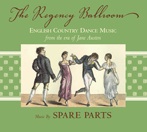
    The very short version of this review is: historical dance band Spare PartsThe Regency Ballroom is one of the very best and most diverse recordings available for Regency-era dance music, and everyone should go out and get their own copy to support the making of such recordings.

    The longer version follows.

    But first, a disclaimer: the musicians of Spare Parts are personal friends, the band has played for my Regency Assemblies for the past several years, the selection of dances on this CD parallels the program of those Assemblies, and I served as one of the dance consultants for the recording and thus received a copy of it for free.  Unsurprisingly, I am very pleased with it.  I do not, however, receive any financial benefit from its sales or anything like that.

    So what’s on the CD?

    (more…)

  • The Royal Gallopade

    The Royal Gallopade is an interesting mix of popular 1830s dances, with elements borrowed from country dances, galopades, and quadrilles, plus a concluding sauteuse waltz.  My only source for it is the Companion to La Terpsichore Moderne (Second Edition) by J. S. Pollock, London (see update at end of post).  It is undated, but the mix of dances and a textual reference to an 1829 event suggests the early 1830s.  Pollock claims that gallopades “appear” to be of Russian origin.  Among those he credits with their introduction is the sixth Duke of Devonshire, who was a close friend of both the Prince Regent (later George IV) and Czar Nicholas I and had traveled to the Russian court.

    Pollock depicts the original gallopade as a choreographed sequence dance for a circle of couples with gallop interspersed with short dance figures and gives not only this original but gallopades in country dance and quadrille form.  Fittingly, the Royal Gallopade is given a separate section of its own between the quadrille and country dance gallopades.

    (more…)

  • What Did Jane Austen Dance?

    Since early 19th century (“Regency”) dance is one of my particular specialties, I get many questions that boil down to either “what did Jane Austen dance?” or “did Jane Austen dance _____?”  So let’s see what I can do for a general answer.

    I can divide things loosely into three categories: what we know she danced, what she might have danced, and what she didn’t dance.

    (more…)

  • Ballroom Marsupials

    The most popular “animal dances” of the early 1900s appear to have been the Turkey Trot and Grizzly Bear.  But the F. Leslie Clendenen’s compilation manual Dance Mad (St. Louis, 1914) offers a pair of one-step variations attributed to London dance teacher Walter Humphrey, who apparently found inspiration in the hopping of Australian marsupials.  I’ve never found these variations in any other source, so it’s not clear to me how widespread they ever were.  I would also have placed them a bit earlier, maybe 1908-1910, as by 1914 the animal dance fad was already well past and the smoother, more elegant style of Vernon and Irene Castle was making the one-step acceptable in respectable ballrooms.  It’s possible that Mr. Humphrey and/or English dancers in general had not quite caught up with the latest American dance fads, or that Clendenen was not as fussy in compiling his book as its subtitle, “The Dances of the Day,” suggests.

    For both variations, the dancers both face line of dance.  It’s not clear whether they should retain joined hands in front or open up fully.  I find the latter more graceful, but how much of a priority grace should be while hopping around a ballroom imitating a marsupial is debatable.  Those wishing to study wallaby technique in detail may consult this National Geographic video this video of a wallaby hopping across the Sydney Harbour Bridge(Edited 11/19/2025 to replace vanished video with a new one.)

    (more…)

  • Famous Last Words

    On the lighter side of dance research…

    There’s plenty of silliness in historical dance manuals, ranging from mythological origins of dancing in general to apocryphal stories about the origins of particular dances.  But none of that makes me laugh quite so much as a couple of lines in Foulsham’s Modern Dancing, by Maxwell Stewart, published in London around 1925 and ambitiously subtitled “A guide to everything the dancer old and young, skilled and unskilled, wants to know.”  That was rather optimistic of Stewart; this particular dancer wishes he had included a lot more detail about some of the moves he described.  But the following has got to be one of the most risible lines I’ve ever found in a dance manual.

    (more…)

  • The Racket Waltz, or The Society

    • Era: 1880s into very early 1900s

    The simplest description of the racket waltz is that it is the step of the one-slide racket converted to waltz time, with the extra beat of music per measure added to the initial slide.  Edna Witherspoon, in The Perfect Art of Modern Dancing (1894), gives it the alternate title “The Society” and notes that “if thoughtlessly executed, it is a most ungraceful and unattractive dance.”  Allen Dodworth, in Dancing and its Relation to Education and Social Life (1885), adds that “The racket, in this accent, is that unfortunate dance known as the “Society,” and is the medium through which not a few show an entire absence of good taste in motion.”  Honestly, it’s not that bad!  It does not seem to have been quite as popular or well-known as the galoptime rackets I described earlier this summer, but it is an easy dance that works well to brisk waltz music.

    (more…)