Month: October 2017

  • November 2017 Gig Calendar

    I'm fully settled in Moscow now, and my November teaching schedule here is a pleasant mix of modern waltz and early twentieth century dance, continuing my work with Studio "Танец весны"  and teaching advanced waltz classes on my own.  I'll also be making a lightning trip back to the USA on Remembrance Day weekend to return to my long-running engagement leading 1860s dancing at The President's Remembrance Day Ball in Gettysburg!

    I do not have much availability for the rest of 2017, but groups in Moscow or elsewhere in Russia or Europe that might be interested in workshops should contact me directly.

    (more…)

  • Who is Your Partner?

    What would Halloween be without masks?  And what would a cotillion be without at least one figure where people blunder around blindly crashing into each other?

    “Who is Your Partner?” is from St. Louis dancing master Jacob Mahler and appeared in Original Cotillion Figures (St. Louis, 1900), his collection of figures from himself and other dancing masters.  It is easy enough to run, but it does require props:

    A number of black masks, like those used in lodges, viz: those that have no eyes, in order to completely blindfold the wearer.

    Here’s how it goes:

    (more…)

  • Un jeu d’échecs (a game of chess), 1810

    Another themed quadrille described by Laure Junot, the Duchess of Abrantès, was the “game of chess” danced, or at least presented, at a masked ball in Paris in the February of 1810.  The quadrille was also described in her Memoires de Madame la duchesse d’Abrantes, which were published and republished in multiple volumes in a variety of editions.  The French text below was taken from an 1837 fourth edition published in Brussels, which may be found online here.  A contemporary (1833) English translation is online here, but it is not a close enough translation and omits some lines, so I’ve done my own, with reference to it.

    Junot spent more time in her memoirs complaining about the costumes and rehearsal time required for this quadrille than she did on the actual performance, but from her description, it seems like very few of the pieces (dancers) actually got to do much, unless perhaps they danced as they entered the board.  But what little she describes does mention steps, and the costume descriptions give us a fairly good idea of how the dancers must have appeared: vaguely Egyptian pawns with tightly-wrapped skirts and sleeves like mummies and sphinx-like hairstyles, knights like centaurs with horse rumps made from wicker, rooks wearing wicker towers, and fools (bishops) in caps with bells.

    (more…)

  • A Fancy Dress Ball, Saratoga, 1847

    Another costume-heavy description of a fancy dress ball was published in The New York Herald on August 17, 1847, in the social column “The Watering Places” on page two.  The ball was held at Congress Hall of the United States Hotel in the summer resort town of Saratoga Springs, New York, on August 14, 1847.

    Sadly, no information is given about the dancing, though the writer does mention the generous size of the hall, one hundred and fifty by fifty feet, and the beautiful decorations, featuring flowers and greenery plus “miniature flags of every nation which supports a navy” hanging “just above the heads” of the dancers.

    (more…)

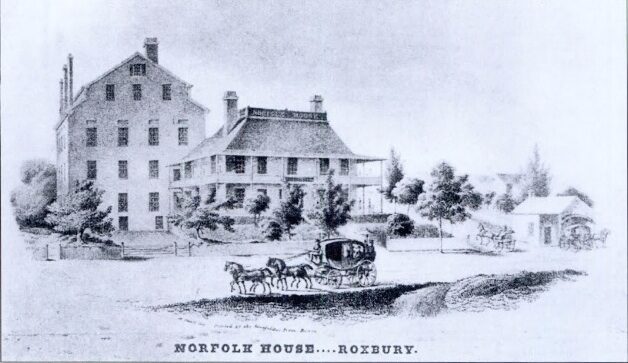
  • A Fancy Dress Ball, Roxbury, 1827

    It’s October, and time once again to devote some attention to masquerade and fancy dress balls and other excuses to wear unusual costumes in historical ballrooms!

    On January 3, 1828, The New York Mirror: A Weekly Gazette of Literature and the Fine Arts, published a description of what was supposedly the first fancy-dress ball ever held in New England, held at Norfolk House in Roxbury, Massachusetts, on “Wednesday last”.

    (more…)