
Category: Victorian

  • Late Victorian Waltz Variations: Fascination

    Fascination is another of the myriad minor waltz variations given by dancing master M. B. Gilbert, in his Round Dancing (Portland, Maine, 1890), who includes the dance “by permission of D. B. Brenneke”, presumably the creator.  It is essentially a longer and slightly more complex elaboration on the Gavotte Glide.

    Gilbert’s description reads:

    First Part:–Slide left foot to side (2d), 1, 2; draw right to left, placing weight on right, 3; one measure. Repeat one measure. Slide left to side, 1, 2; draw right to left and slide left to side (chassé), & 3; one measures. Draw right to left and slide left to side, & 1, 3; draw right to left, placing weight on right. 3; one measure.

    Second Part:–Waltz four measures. Recommence at first part.

    Counterpart for lady.

    The dancers are in standard waltz position, the gentleman facing the wall.  The lady dances the same moves on opposite feet.
    (more…)

  • La Russe

    (Note 6/3/24: I’ve written a follow-up to this post; the link is at the end.  My reconstruction stands.)

    I picked La Russe out some time ago while looking for easy late nineteenth century waltz-time variations.  The name means “the Russian woman”, and I recently had the pleasure of teaching it in Moscow to a very talented group of Russian dancers.

    No specific choreographer is known for La Russe, but we can date it with unusual precision to just over 130 years ago.  Dancing master M. B. Gilbert, in his Round Dancing (Portland, Maine, 1890), noted that it was “introduced by the American Society of Professors of Dancing, New York, May 1st, 1882,” and it turns up in a couple of other American dance manuals of the 1880s.  All the descriptions are quite consistent, though the terminology used varies.

    (more…)

  • Late 19th Century Jig-Time Dances: The Bronco

    Like the Rockaway, the Bronco is another dance listed under the “Miscellaneous” category in M.B. Gilbert’s Round Dancing (Portland, Maine, 1890) as suitable for either jig time (6/8) or galop time (2/4). 

    Please see my earlier post on the Rockaway for a discussion of jig and galop rhythms and a sample of jig music.

    Original description

    Leap backward from the right to left foot, 1; leap backward upon the right foot, 2; leap backward upon the left, 3; pass right to side and immediately draw left to right (à la Newport), & 4; pass right to side and draw left to right, & 5; leap forward upon the right, 6; pass left to side and draw right to left, & 7; pass left to side and draw right to left, & 8; four measures.  Repeat, commencing as at first. The second time the right foot may move backward at the sixth count, making the turn to the left.  Counterpart for lady.
            —  Gilbert, Round Dancing, p.165

    (more…)

  • Late 19th Century Jig-Time Dances: The Rockaway

    I’ve recently been looking more closely at some of the “Miscellaneous Dances” found in the back of M. B. Gilbert’s 1890 tome, Round Dancing, and noticed that quite a few of the dances there are labeled specifically as for dancing to jig time (6/8) or for either jig or galop (2/4) time.  The Rockaway is one of those given as suited for either time signature.

    The earliest source I have for this dance is a New York dance manual, and it seems likely that it was named for the Rockaway Peninsula, a part of Long Island which was a popular seaside resort area in the nineteenth century.  The description in Gilbert is considerably clearer and is the basis for this reconstruction.

    (more…)

  • CD Review: Returning Heroes

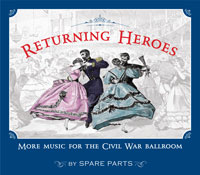
    Brand new this month — the release party is coming up in a couple of weeks — is the dance band Spare Parts‘ latest CD of mid-nineteenth-century dance music, Returning Heroes.  After dancing for many years to music from their earlier CD, The Civil War Ballroom, it’s a delight to have new music for this era!

    The short review: it’s a great CD; buy it immediately if you enjoy dancing of the Civil War era.

    The longer version follows.

    Disclaimer: the musicians of Spare Parts are personal friends, and my advance copy of this CD was sent to me as a gift.

    (more…)

  • Harvest Home

    • Era: American, late 1850s-early 1860s

    In commemoration of the American Thanksgiving holiday, here’s a seasonally appropriate dance from the American Civil War era, a country dance for a set of six couples.

    While I have not done a comprehensive search, I appear to have instructions for “Harvest Home” only in a pair of dance manuals by Elias Howe: Howe’s Complete Ballroom Handbook (Boston, 1858) and American Dancing Master and Ball-Room Prompter (Boston, 1862), which include far more country dances than is typical of other dance manuals of the time period.  New England to this day retains a stronger country dance tradition, in the form of modern contra dance, than most other parts of the United States.

    (more…)
  • Star Schottische

    One of the myriad minor schottische variations described in M.B. Gilbert’s Round Dancing (1890), is notable as the earliest appearance I’ve noticed of what has become the standard style for the first part of modern folk schottische: three running steps forward in “military position” (as described in my previous post, “À la Militaire“) rather than the step-close-step of the nineteenth century dance.

    Gilbert attributes the Star Schottische to W.F. Mittman.

    (more…)

  • The Newport

    A new waltz or redowa variation pops up in a few of the manuals of the very late nineteenth century.  Presumably named after the wealthy resort town, the Newport appears in slightly different versions in different manuals, but the common element appears to be a series of quick sliding steps.

    Apparently the Newport was too new to be included in New York dancing master Allen Dodworth’s Dancing and its relations to education and social life  (New York, 1885).  The earliest and clearest description I have found is in M. B. Gilbert’s Round Dancing, published in Portland, Maine, in 1890.  His version, included “by permission of Russ B. Walker,” is essentially an ornamented version of the standard waltz of the late nineteenth century, with two rapid slides to the side rather than one in each bar for a “step-side-close-side-close” sequence rather than the usual “step, side, close.”  A half-turn is made on each bar, just as in the regular late nineteenth-century waltz, with a complete turn every two bars.

    (more…)

  • Le Triangle

    Subtitled Nouveau Quadrille, Le Triangle is not actually a quadrille in the literal sense of a dance involving facing couples.  It was composed by F. Paul and published in his manual, Le Cotillon, in Paris in 1877 and is danced by three couples rather than four, arranged in the form of a triangle.  Paul composed it to address the difficulty of finding four couples for the quadrille croisé of the time.  He adds modestly that he does not intend to impose it upon dancers, but gives the description only as a proposal.  I have never seen Le Triangle in any other source; it may never have been danced outside of Paul’s immediate circles.

    (more…)

  • Late Victorian Waltz Variations: The Bowdoin

    This is the final post in this month’s little series of easy and useful late nineteenth century waltz variations from M.B. Gilbert’s 1890 manual, Round Dancing.  The first three posts in the series may be found here, here, and here.

    Gilbert notes of the Bowdoin that he “applied these movements to the Waltz during the seasons of 1888-89, and found the application very pleasing.”

    Once again, this variation will work either leaping or simply gliding the waltz steps, with my preference being for the smoother transitions allowed by the gliding version.

    (more…)